
Product Details
On a multirotor, the arm tubes carry three loads simultaneously: motor torque at the tip, bending from thrust and wind, and vibration from the propellers. Getting the tube spec wrong means either a heavy frame that kills your flight time, or a flexible arm that lets the prop wash wag the motor and destroy your footage. We’ve been building drone frames since we exhibited at the 2025 World UAV Expo, and we’ve learned that there’s no universal “drone tube” — the right wall thickness and layup depend on your wheelbase, motor weight, and whether you’re flying a camera platform or a racing quad.
The most common mistake we see is over-specifying wall thickness. A 16mm × 2mm tube weighs nearly double a 16mm × 1mm tube, but the stiffness difference on a 300mm arm span is only about 40%. That extra gram per arm adds up fast — four arms on a 7-inch quad and you’ve burned 4 grams for no meaningful rigidity gain. We recommend starting with the lightest wall that meets your deflection target, then stepping up only if flight testing shows visible motor oscillation or arm resonance.
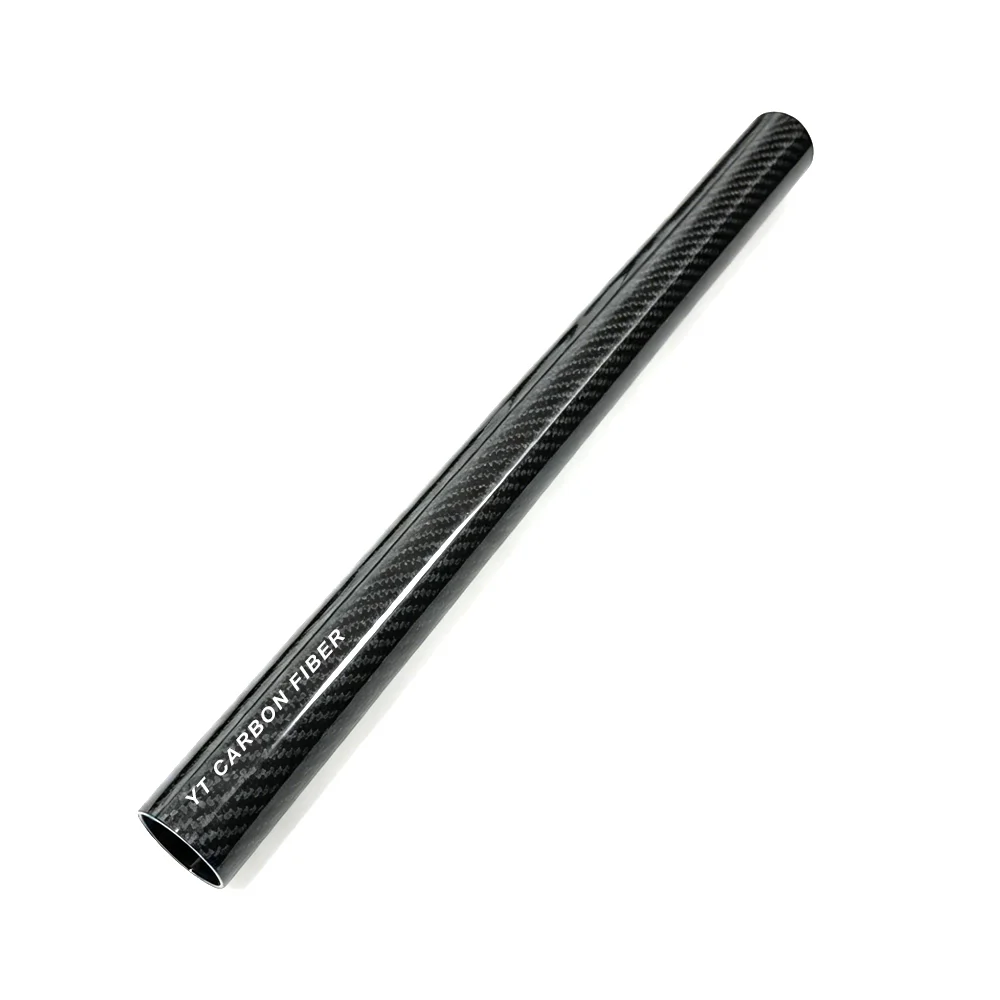
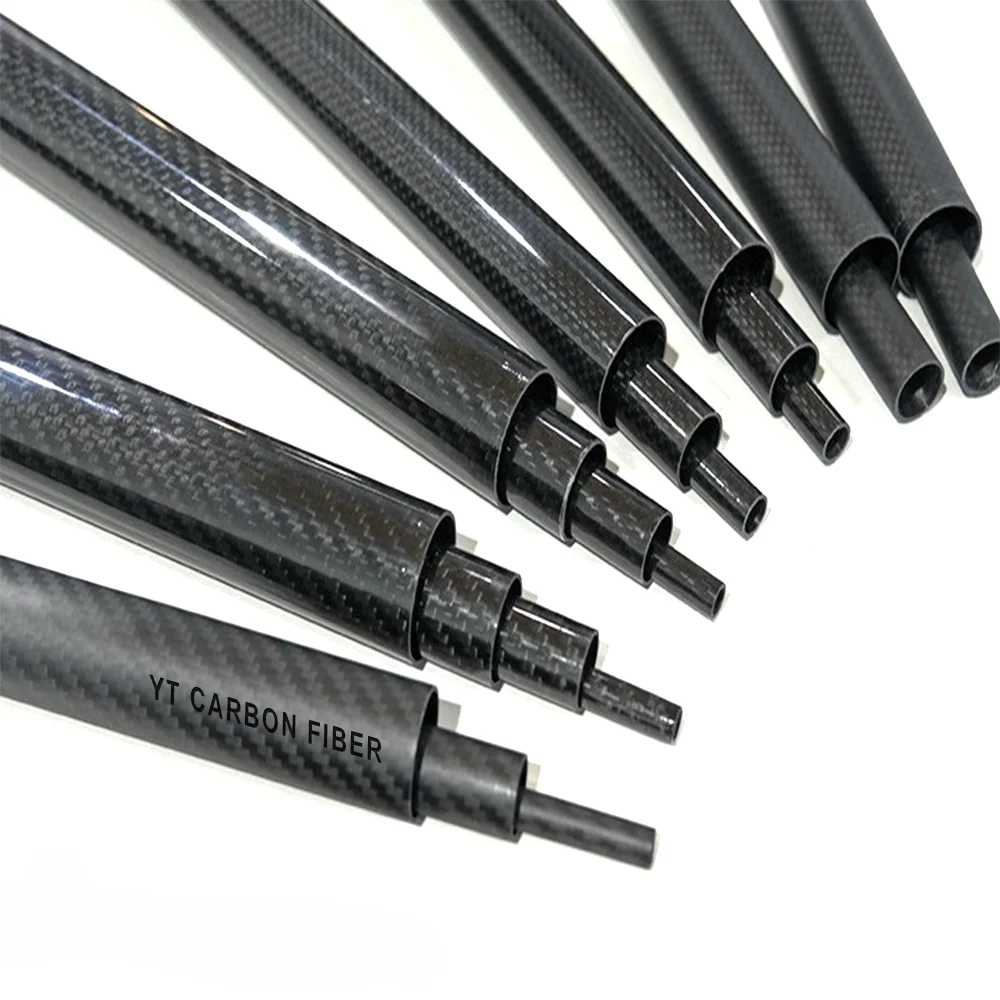
Our drone arm tubes are roll-wrapped with a hybrid layup: 0° UD plies in the core for bending stiffness, ±45° plies for torsional resistance at the motor mount, and a 3K twill outer wrap for impact tolerance and crack arrest. This isn’t a generic schedule — we adjust the ply ratio based on your arm length and load. For camera platforms with long arms (400mm+), we add extra ±45° plies. For racing frames with short arms under 200mm, we keep the wall thin and the UD content high. Every tube ships from our Shenzhen factory with dimensional data and layup documentation.
Specifications
| Specification | Details |
|---|---|
| Material | T300/T700/T800 carbon fiber (drone-optimized) |
| Process | Roll-wrapped (hybrid layup) |
| Cross-Section | Round / Square |
| Common OD Range | 8mm – 30mm (drone-specific) |
| Wall Thickness | 0.5mm – 3mm |
| Arm Length (typical) | 150mm – 500mm per arm |
| Layup | 0° UD core + ±45° shear + 3K twill outer |
| Surface Finish | Glossy (3K twill) / Matte |
| Fiber Volume Fraction | 60–65% |
| Density | 1.55–1.60 g/cm³ |
| Deflection Target | < 2mm at full thrust (per arm, 300mm span) |
| Impact Resistance | 3K twill outer layer for crack arrest |
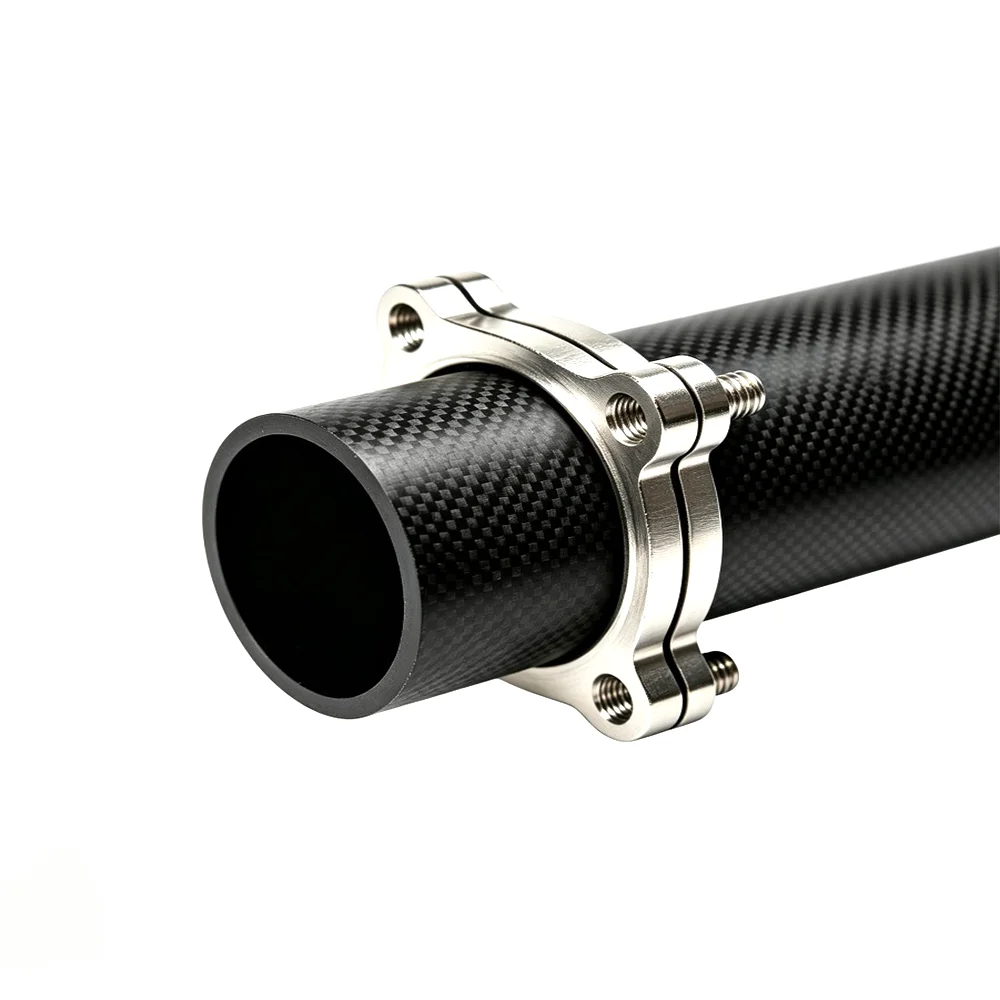
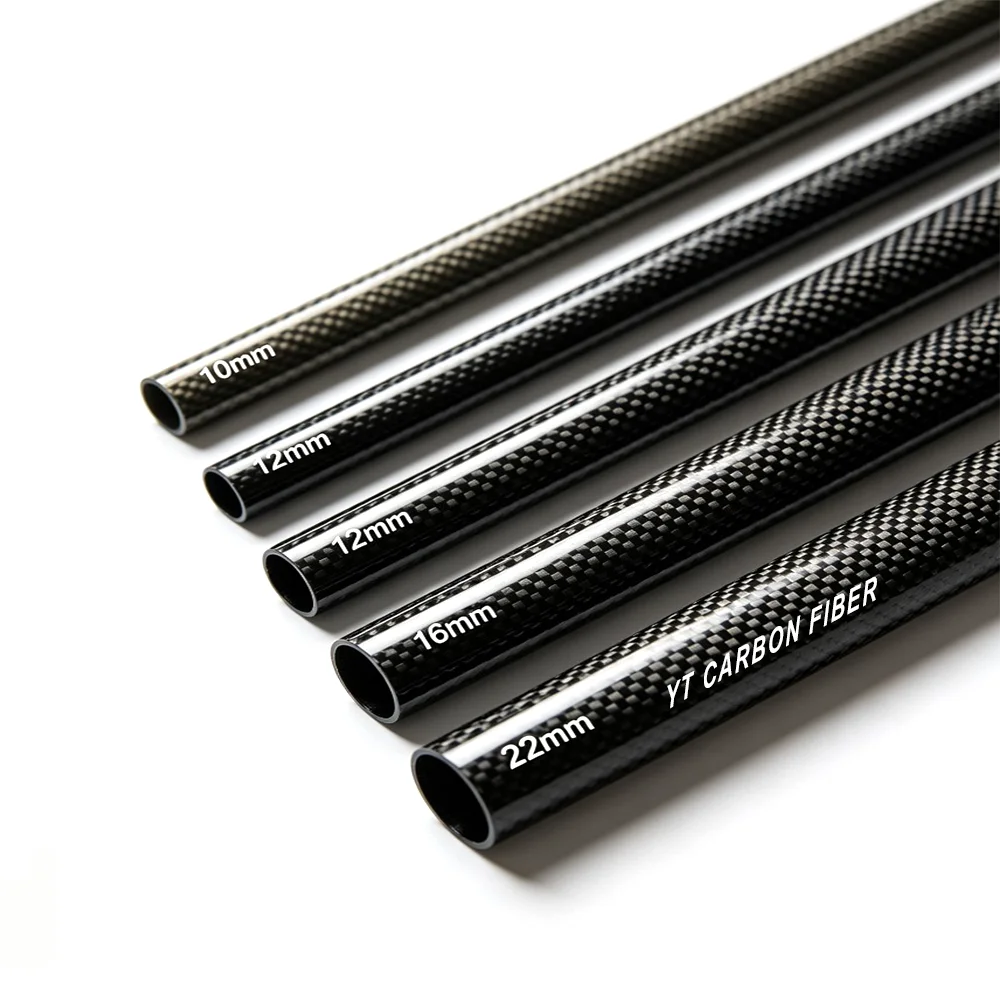
| Motor Mount Compatibility | Standard 12mm / 16mm / 22mm clamp sizes |
| Operating Temperature | -40°C to 120°C |
Applications
- Cinematic camera platforms — Long arms (350mm+) need stiff tubes that resist motor oscillation under heavy camera payloads. We spec ±45°-heavy layups with extra torsional rigidity for smooth footage
- Industrial inspection UAVs — Arms that carry lidar, thermal cameras, and comms gear. Weight budget is tight, every gram saved on the arm is a gram available for payload. Custom OD/ID for your motor clamp
- Racing and freestyle quads — Short arms, aggressive maneuvers, hard landings. Thin-wall tubes (0.5–1mm) keep the weight down; the 3K twill outer layer absorbs impact without splintering like a UD-only pultruded tube
- Fixed-wing UAV spars — Carbon fiber tubes as wing spars and tail booms. The hybrid layup resists both bending (from lift) and torsion (from control surfaces) in a single efficient profile
- Agricultural spray drones — Heavy liquid payloads mean the arms carry constant bending load plus chemical exposure. Our epoxy system resists common agricultural chemicals and UV degradation
Why Choose YTCarbon
- Drone-specific engineering. We don’t just sell tubes — we help you spec them. We exhibited at the 2025 World UAV Expo with our own frame line, and we’ve built enough drones to know that wall thickness and layup make or break your flight performance. Tell us your frame and we’ll recommend the tube
- Hybrid UD + twill layup. The UD core delivers bending stiffness where drones need it most. The ±45° plies fight motor torque. The 3K twill outer stops cracks from propagating on impact. One tube, three functions — no generic off-the-shelf schedule
- Weight vs stiffness calculator. Send us your arm length, motor weight, max thrust, and target hover time. We’ll calculate the lightest wall thickness that keeps deflection under 2mm at full thrust. No overbuilding, no wasted grams
- Standard motor clamp sizes in stock. 12mm, 16mm, and 22mm OD tubes ready to ship. These are the most common clamp sizes on commercial and industrial drone frames — no custom machining needed for motor mounts
- Crash replacement pricing. Drones crash. We know. For OEM customers, we offer crash-replacement tubes at cost — because you shouldn’t have to choose between flying again and paying full price
Certifications
Every drone arm tube we ship carries documented quality credentials. Our facility holds ISO 9001 certification for quality management, and our carbon fiber materials are RoHS and CE compliant — required if you’re selling UAV systems into the EU or supplying defense customers who need traceable material documentation. Need a copy for your records? Just ask and we’ll send the PDF.

How We Manufacture Your Tube
Drone arm tubes demand tighter process control than general-purpose CF tubing because the weight-stiffness trade-off is razor-thin. We start by cutting pre-preg to the ply angles specified in your drone’s laminate schedule, then wrap each ply onto a precision-ground mandrel under controlled tension. The hybrid layup — UD core, ±45° shear plies, 3K twill outer — is built in sequence, not mixed. After vacuum-bagging and oven cure, each tube is measured for OD at three points to verify it fits your motor clamps (tolerance ±0.05mm). We also weigh every tube and record the result — if a 16mm × 1mm tube comes out heavier than expected, something went wrong in the layup and we remake it before it ships.

Frequently Asked Questions
+ What wall thickness do I need for drone arm tubes?
+ Should I use round or square carbon fiber tubes for drone arms?
+ Weight savings vs aluminum?
+ Best layup for drone arm?
+ Match existing frame dimensions?
Need Carbon Fiber Drone Arm Tubes?
Tell us your frame specs — we’ll recommend the lightest tube that meets your deflection target. Hybrid layup, crash replacement pricing, and standard clamp sizes in stock.