Octagonal vs. Round Carbon Fiber Tubes: Solving UAV Motor Slippage
A Design for Manufacturability (DFM) engineering comparison on eliminating motor bracket twisting, bolt shear failure, and structural deflection in commercial drone airframes.
The Hidden Vulnerability of Round Tubes
Cylindrical carbon tubes remain the traditional standard for multirotor booms. They provide balanced longitudinal stiffness. In addition, their circular cross-section is easy to manufacture. However, heavy-payload drones introduce severe mechanical challenges. Heavy industrial motors generate extreme dynamic torque during sudden maneuvers.
Consequently, standard round clamps often slip under abrupt rotational shocks. Engineers frequently attempt to fix this issue by adding through-bolts. However, drilling radial holes severs continuous structural fibers. As a result, micro-cracks propagate quickly around the bolt holes, causing unexpected structural fatigue during flight.
Positive Mechanical Locking Without Drilling
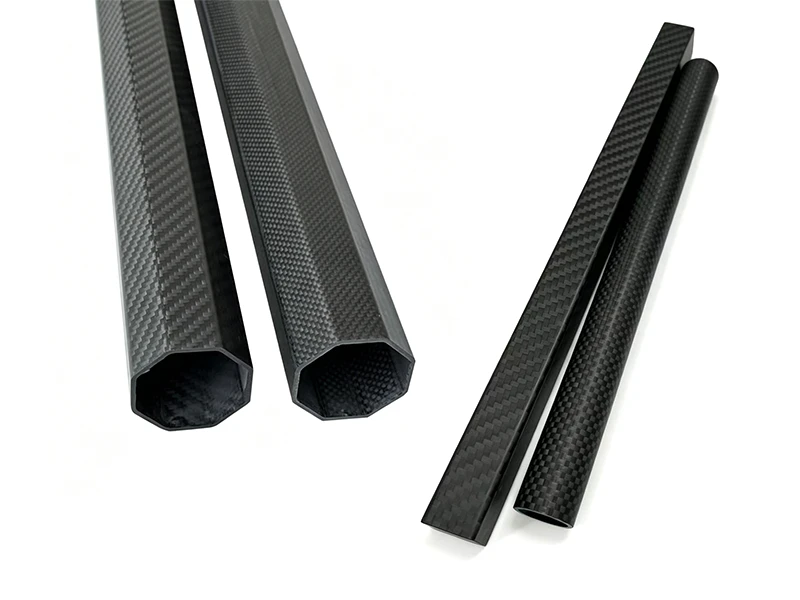
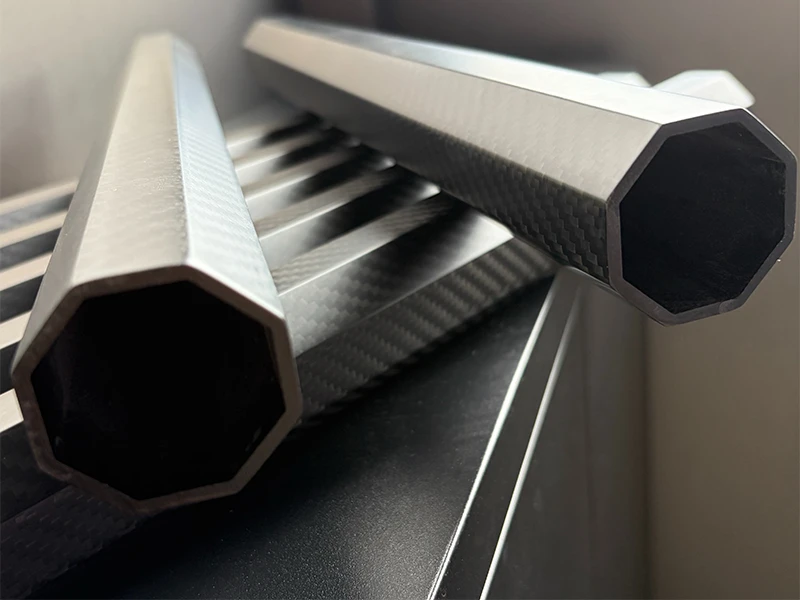
Deploying an octagonal carbon fiber tube solves this rotational hazard permanently. Specifically, the eight symmetrical flat facets provide positive mechanical interlocking. Matching CNC aluminum brackets seat flat against the tube faces. Therefore, the motor bracket cannot twist, even under extreme torque reversals.
Furthermore, square tubes also prevent rotation, but their sharp 90-degree corners experience severe stress concentrations. In contrast, octagonal tubes distribute clamp loads evenly across eight gradual angles. Therefore, they deliver superior aerodynamic efficiency while maintaining high torsional rigidity across demanding carbon fiber drone frames.
Cross-Sectional Architecture Comparison for UAV Arms
Evaluating tube profiles highlights how cross-sectional geometry impacts flight reliability:
| Geometric Profile | Anti-Twist Mechanism | Stress Concentration | UAV Suitability Verdict |
|---|---|---|---|
| Standard Round Tube | Friction-only (Requires through-bolts) | High around drill holes | Suitable for consumer quads, but risky for heavy industrial payloads. |
| Square Tube | 4 flat locking planes | Severe at 90° corners | Easy to mount, but corners suffer high stress peaks and aerodynamic drag. |
| Octagonal Tube | 8 flat interlocking facets | Low (Even 135° load distribution) | Optimal standard for agricultural, logistics, and heavy eVTOL arms. |
Manufacturing Standards for High-Reliability Drone Arms
Selecting the right tube profile is vital. However, manufacturing precision determines structural safety. When sourcing an octagonal carbon fiber tube for drone arms, engineers should verify three core production standards:
1. Multi-Axial Prepreg Roll-Wrapping: Never specify pultruded tubes for multirotor booms. Pultrusion aligns fibers only longitudinally. As a result, pultruded tubes split easily along their length. In contrast, roll-wrapping integrates ±45-degree plies. These angled fibers handle high torsional shear and dynamic motor resonance.
2. High-Precision Mandrel Tooling: Octagonal geometry demands crisp corner definition. In addition, wall thickness must remain consistent across all eight flats. Therefore, our factory cures prepreg plies over hardened steel mandrels within ±0.1mm tolerance. This prevents localized resin richness and guarantees uniform clamping contact.
3. One-Stop CNC Post-Processing: Routing slots for motor cables often damages laminate edges. Therefore, cutting must be performed with specialized CVD diamond tools. At YTCarbon, we produce custom octagonal tubes and matching custom CNC machined parts in-house to deliver burr-free, assembly-ready components.
Frequently Asked Questions
About the Author: Ken & YTCarbon Engineering Team
Ken is the General Manager and Technical Lead at YTCarbon (Shenzhen Yuantan New Materials Technology Co., Ltd.). With extensive experience in multi-axis roll-wrapping, hydraulic hot pressing, and diamond CNC routing, our engineering division develops custom composite structural solutions for industrial drones, robotics, and aerospace clients worldwide.