Flame Retardant vs. Standard Carbon Fiber: Engineering Selection Guide
Using certified flame retardant carbon fiber is becoming critical as composites rapidly expand into fire-sensitive sectors like eVTOL aircraft, industrial UAVs, and EV battery enclosures. Here is how fire-inhibiting matrices differ from standard resins and when you should specify them.
1. What Makes Flame Retardant Carbon Fiber Unique?
To understand fire performance in composite structures, we must evaluate both the carbon reinforcement and the polymer matrix:
- The Carbon Reinforcement: Continuous carbon fiber filaments naturally withstand temperatures exceeding 1000°C in non-oxidizing environments without melting.
- The Polymer Matrix: Standard epoxy resins ignite readily when exposed to open flame. In contrast, flame retardant carbon fiber utilizes a modified, halogen-free resin system certified to UL 94 flammability standards.
Specifically, when exposed to direct fire, the specialized matrix forms an intumescent char barrier that deprives the interior plies of oxygen, self-extinguishing within 10 seconds with zero burning drips. You can also explore our dedicated UL94 V-0 composite product series for full mechanical datasheets.
2. Property Comparison: Flame Retardant vs. Standard Carbon Fiber
| Feature / Property | Standard Carbon Fiber Sheet | Flame Retardant Plate (FR Series) |
|---|---|---|
| Flammability Standard | Unrated / HB (Slow burning) | UL94 V-0 Certified (≤10s self-extinguish) |
| Combustion Behavior | Continues burning until resin consumes | Forms intumescent char, zero drips |
| Smoke & Gas Toxicity | Standard epoxy smoke output | Low optical smoke density, halogen-free |
| Mechanical Modulus | 100% Baseline stiffness | >95% of standard high-modulus baseline |
| Laminate Density | Approx. 1.55 g/cm³ | Approx. 1.58 g/cm³ (<2% weight penalty) |
| Target Sectors | RC hobby, sports gear, general plates | eVTOL, Industrial UAVs, EV battery lids |
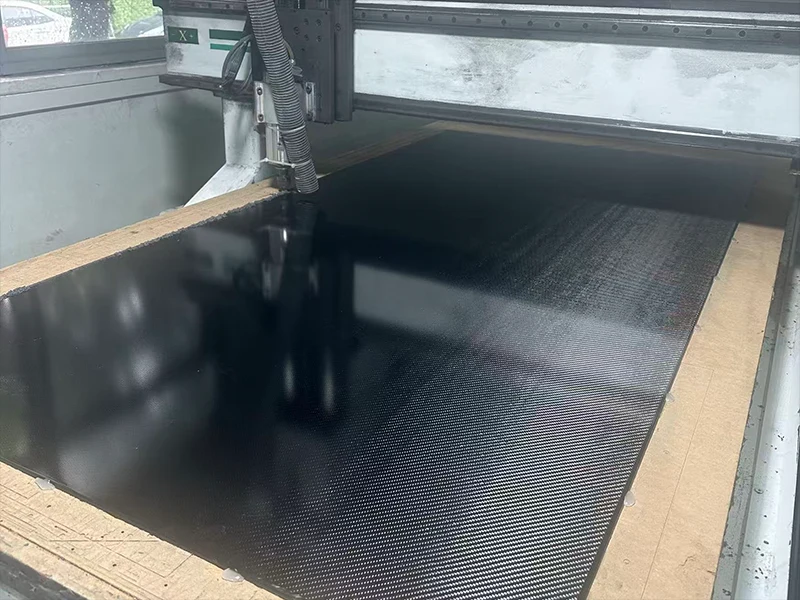
Precision CNC machined fire resistant composite components for aerospace and battery assemblies
3. Applications Demanding Flame Retardant Carbon Fiber
1) Low-Altitude eVTOL & Commercial UAV Airframes
With airworthiness standards tightening globally, commercial delivery drones and passenger eVTOLs require structural materials that pass strict vertical burn tests. Consequently, engineers use fire-retardant panels for fuselage bulkheads, motor mounts, and avionics bays to preserve flight integrity during electrical anomalies.
2) EV Battery Enclosures & Thermal Runaway Shields
Electric vehicle battery modules face severe thermal runaway risks during cell puncture. Incorporating 1.0mm to 2.0mm fire-rated composite plates as protective top lids provides a lightweight barrier against metal burn-through, directly safeguarding passenger cabins.
3) High-Voltage Electrical & Robotics Enclosures
Industrial robotic control panels, power inverters, and server rack structural brackets operating near high-heat machinery mandate UL-listed fire resistance to comply with international industrial safety codes.
4. Manufacturing & CNC Machining Considerations
When specifying custom fire-resistant composite panels, keep these technical manufacturing factors in mind:
- Specify Quasi-Isotropic Layups: For structural chassis subjected to multi-axis loading, request a balanced
[0°/±45°/90°]ply schedule to guarantee equal tensile stiffness in all lateral directions. - Diamond Tooling for Clean CNC Edges: Flame retardant resin formulations are slightly tougher than standard matrices. Ensure your manufacturing partner uses diamond-coated router bits with vacuum cooling to prevent edge delamination. Check our precision CNC machining capabilities for tight ±0.05mm tolerances.
Frequently Asked Questions
Material & Fire Safety Questions
Need Certified Fire-Resistant Carbon Fiber Plates?
Manufactured from 0.5mm to 25mm thickness under certified UL94 V-0 standards. Send us your dimensions or CAD drawings for an instant factory quote within 24 hours.