Why Carbon Fiber Telescope Tubes Outperform Aluminum
A telescope tube does more than hold mirrors and lenses — it defines your optical alignment, focus stability, and image quality. When temperature drops 15°C during a night of observing, the wrong tube material can ruin your session. Here is why astronomers worldwide are switching from aluminum to carbon fiber telescope tubes.
Why Tube Material Matters for Telescopes
A telescope tube is not just a structural housing — it is part of the optical system. Consequently, the tube material directly affects three performance-critical parameters: focal distance stability (does focus drift with temperature?), mechanical rigidity (does the tube flex under load?), and vibration damping (how fast does the image settle?).
Aluminum has been the default telescope tube material for decades. Admittedly, it is cheap, easy to machine, and widely available. However, aluminum has a thermal expansion coefficient of 23 × 10⁻⁶ /°C — meaning a 1-meter tube shrinks 0.23mm for every 10°C drop. That is enough to shift focus noticeably in fast optical systems, forcing astrophotographers to refocus repeatedly throughout the night.
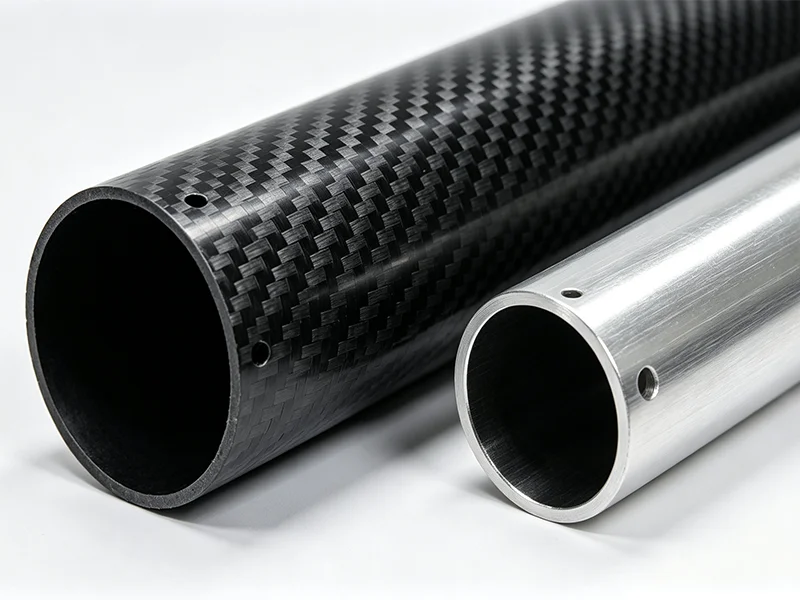
Carbon fiber composite, by contrast, has a CTE of less than 2 × 10⁻⁶ /°C along the fiber axis — roughly 10 times lower than aluminum. A carbon fiber telescope tube shrinks only 0.02mm under the same 10°C drop, which is virtually undetectable. Combined with one-third the weight and 2–3× faster vibration damping, carbon fiber solves the three problems aluminum creates.
Thermal Expansion: The Hidden Focus Killer
During a typical observing session, the temperature drops significantly from sunset to midnight — often 15–20°C. This temperature change causes metal telescope tubes to contract, shifting the focal plane and blurring stars. The effect is most pronounced in fast optical systems (f/4 to f/6) where the depth of focus is shallow.
Consider a concrete example: a 900mm focal length Newtonian with an aluminum tube. During a 15°C nighttime temperature drop, the tube contracts by approximately 0.31mm. At f/4.5, this shifts the focal plane far enough to turn pinpoint stars into bloated disks within 30–45 minutes. Consequently, astrophotographers using aluminum tubes must refocus every 20–30 minutes or invest in motorized focusers with temperature compensation.
The same telescope built with a carbon fiber tube contracts only 0.027mm over the same 15°C drop — well within the depth of focus. As a result, focus remains locked from dusk to dawn. Many astrophotographers report going entire nights without touching the focuser after initial focus, simply because the carbon fiber tube does not move.
Property Comparison Table
| Property | Aluminum | Steel | Carbon Fiber |
|---|---|---|---|
| CTE (×10⁻⁶/°C) | 23 (high) | 12 (moderate) | < 2 (near zero) |
| Density (g/cm³) | 2.7 | 7.85 | 1.6 |
| Specific Stiffness | Good (~26 GPa / 2.7) | Moderate (~27 / 7.85) | Excellent (~130 / 1.6) |
| Weight (60mm OD × 1m) | ~280 g | ~810 g | ~95 g |
| Vibration Damping | Low — rings 2–3s | Low — rings 3–4s | High — settles ~1s |
| Corrosion Resistance | Poor — oxidizes | Poor — rusts | Excellent — no rust |
| Thermal Conductivity | High (205 W/m·K) | Moderate (50) | Low (< 5 along axis) |
| Stray Light Reflection | High — needs flocking | High — needs painting | Low — matte option |
| Upfront Cost | Low | Low | Higher |
| Best Use Case | Budget visual | Heavy mounts | Astrophotography |
Weight: Lighter Tube, Better Mount
A carbon fiber telescope tube weighs approximately one-third of an aluminum tube with equivalent stiffness. For a typical 8-inch Newtonian OTA, switching from aluminum to carbon fiber can save 1–2 kg — a significant reduction that directly improves mount performance.
Lighter OTA weight means you can use a smaller, less expensive mount. For instance, a mount rated for 8kg can handle a carbon fiber 10-inch Newtonian that would overload it with an aluminum tube. Furthermore, reduced weight lowers the moment of inertia, allowing the mount to track more accurately and slew faster — particularly important for astrophotography where tracking precision determines image quality.
For portable setups, the weight savings are even more impactful. A carbon fiber travel scope can pack the same aperture as an aluminum model at one-third the tube weight, making it practical to carry on hiking trips or flights. Moreover, lighter tubes put less stress on mount gears and bearings, extending equipment life over years of use.
Vibration Damping: Faster Settling, Sharper Frames
Every astronomer knows the frustration: you slew to a target, and the image shakes for several seconds before settling. Wind gusts, mount tracking corrections, and even focusing adjustments all induce vibrations that blur the image. The tube material determines how quickly these vibrations die down.
Carbon fiber composites dissipate vibration energy through the resin matrix and fiber-matrix interface far more efficiently than metals. In practice, a carbon fiber telescope tube typically settles in about 1 second after a disturbance, compared to 2–3 seconds for aluminum and 3–4 seconds for steel. This means less waiting between exposures and more time capturing data.
For astrophotographers shooting planetary video at high frame rates, faster settling translates directly to a higher percentage of sharp frames per capture session. For visual observers at high magnification, it means steadier views with less time waiting for vibrations to subside after touching the focuser. Either way, carbon fiber gets you back to observing faster.
Stray Light: Why Matte Finish Matters
Stray light — any light that enters the telescope tube but does not come from the target — reduces image contrast and causes glare. The interior surface of the telescope tube is the primary source of stray light reflections. A shiny aluminum tube interior reflects up to 70% of incident light, bouncing it randomly into the optical path.
Traditionally, astronomers solve this by applying aftermarket flocking material — adhesive velvet-like sheets that absorb stray light. However, flocking adds weight, traps dust, and can peel over time. Furthermore, aluminum tubes require this extra step before they are observation-ready.
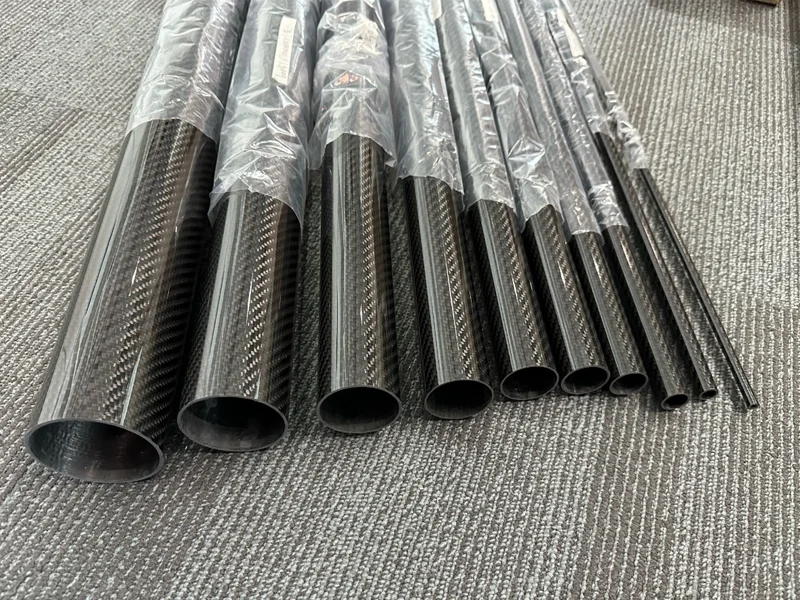
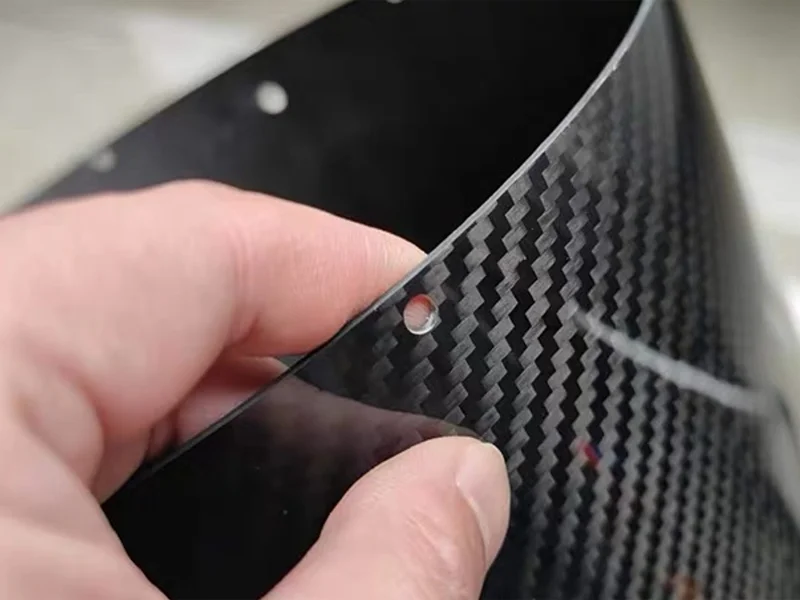
Carbon fiber telescope tubes, by contrast, offer a factory-applied matte interior finish that absorbs over 95% of visible light without any aftermarket treatment. The matte surface is integral to the composite structure — it will not peel, trap dust, or add weight. Consequently, a carbon fiber telescope tube is observation-ready the moment you unbox it, with stray light suppression built into the material itself.
Quick Reference: Recommended Tube by Telescope Type
Why Roll-Wrapped Construction Is Essential
Telescope tubes experience complex loading: the mirror cell pulls downward, the focuser and camera add weight on the side, wind pushes from random directions, and the mount applies torque during slewing. Consequently, the tube must resist bending and torsion from multiple directions simultaneously — not just along its length.
Roll-wrapped tubes use layered prepreg with customizable fiber orientations (0°/±45°/90°). Specifically, the ±45° layers resist torsion and lateral bending from any direction — exactly the loading pattern a telescope tube experiences in real use. The 0° layers provide axial stiffness to maintain focal distance, while the 90° layers resist crushing forces from clamps and mounting rings. This multi-directional layup is the reason roll-wrapped carbon fiber is the only appropriate construction for telescope tubes.
Pultruded tubes, on the other hand, align all fibers at 0° (unidirectional). While they offer excellent axial strength at lower cost, they lack the ±45° layers needed to resist lateral bending and torsion. A pultruded telescope tube would flex under the weight of a mirror cell or camera, compromising optical alignment. For this reason, all our telescope tubes are roll-wrapped — no exceptions.
In summary: telescope tube → roll-wrapped, always. The fiber architecture is what makes carbon fiber telescope tubes work — without ±45° layers, you lose the multi-directional stiffness that keeps optics aligned under real-world loads.
Frequently Asked Questions
Thermal & Performance Questions
Build & Customization Questions
Need Carbon Fiber Telescope Tubes?
Roll-wrapped construction. Matte anti-reflective interior. CTE < 2×10⁻⁶/°C. Custom diameters from 25mm to 160mm OD. Get a tailored quote within 24 hours.