Carbon Fiber Drone Frame Lightweighting for Heavy-Payload UAVs & eVTOL
A comprehensive engineering analysis on breaking battery endurance limits, damping motor harmonics, and optimizing structural rigidity across modern autonomous flight platforms.
The Gravitational Bottleneck in Commercial UAVs
Industrial drones now handle heavy logistics and agricultural spraying. However, propulsion engineers face a stubborn physical barrier. Standard battery energy density remains limited. Expanding battery packs adds significant deadweight. Therefore, aggressive carbon fiber drone frame lightweighting is no longer optional. It has become an essential engineering requirement.
Consequently, every gram removed from structural airframes delivers immediate benefits. Drones achieve longer flight times and carry heavier equipment. However, cutting mass must not reduce airframe stiffness. Flight controllers still require rigid platforms to maintain steady aerodynamic control.
High-Torque Motor Counter-Torque & Resonance Control
Heavy-lift drones run massive 30-inch to 40-inch propellers. These large rotors produce extreme torsional counter-forces during sudden flight maneuvers. Conventional aluminum arms tend to flex under high torque spikes. As a result, thrust angles shift and flight stability degrades quickly.
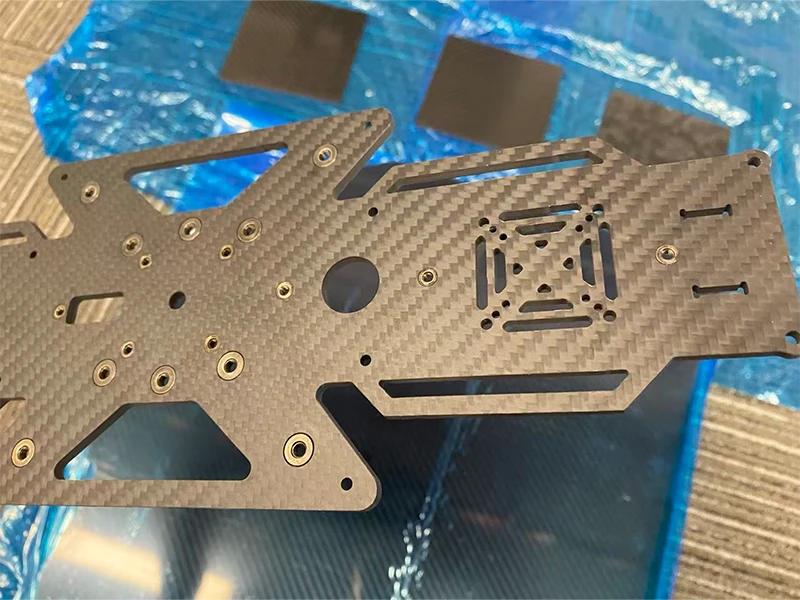
In contrast, deploying structural 4mm carbon fiber sheet and rigid 5mm carbon fiber sheet prevents arm twist entirely. Furthermore, continuous carbon composites absorb vibrations far better than metal alloys. Therefore, they suppress motor resonance effectively and protect sensitive flight sensors from noise.
Structural Material Comparison: CFRP vs. Aviation Alloys
Evaluating raw mechanical data demonstrates why carbon fiber is ideal for flight frames:
| Material Type | Density (g/cm³) | Tensile Strength (MPa) | UAV Airframe Suitability |
|---|---|---|---|
| 6061-T6 Aluminum | ~2.70 | ~310 | Heavy mass penalty; prone to cyclic fatigue micro-cracking. |
| Ti-6Al-4V Titanium | ~4.43 | ~950 | High cost and excessive density; limited to ultra-compact critical fittings. |
| Standard T300 CFRP | ~1.50 | ≥ 500 | Standard baseline for consumer quads and lightweight payload trays. |
| High-Tensile T700 CFRP | ~1.50 | ≥ 900 | Optimal standard for long-range arms, eVTOL spars, and high-G chassis. |
The Engineering Core of Carbon Fiber Drone Frame Lightweighting
Successful mass reduction requires careful composite planning. Specifically, drone developers should focus on three foundational engineering strategies:
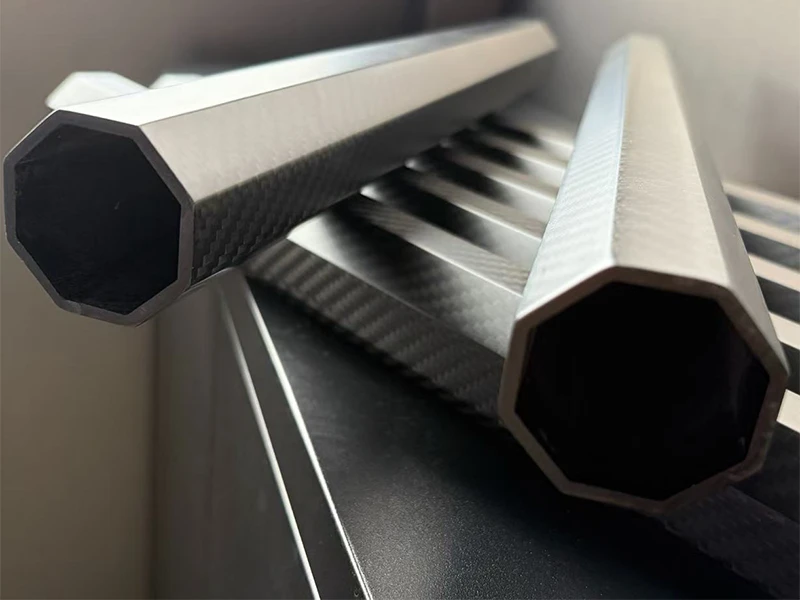
1. Tube Profile Selection: Round tubes offer great longitudinal strength. In comparison, octagonal carbon tubes provide flat mounting faces. These flat surfaces stop motor brackets from slipping under flight loads. Pairing roll-wrapped tubes with custom CNC machined parts produces rigid joints that stay securely locked.
2. Quasi-Isotropic Layup Schedules: Standard 0°/90° fabric performs well in straight bending. However, it can flex under multi-axis loads. Therefore, specifying a quasi-isotropic stack [0°/±45°/90°] is advisable for central chassis plates. This layup schedule guarantees balanced strength across all planes, ensuring exceptional airframe rigidity during sharp maneuvers.
3. Hardware Integration: In addition, airframe hardware accounts for considerable total mass. Traditional designs use heavy aluminum joiners and steel brackets. Instead, our factory presses threaded metal inserts directly into carbon plates. This streamlines overall structural assembly and cuts unnecessary grams without sacrificing fastening strength.
Frequently Asked Questions
About the Author: Ken & YTCarbon Engineering Team
Ken serves as General Manager and Technical Director at YTCarbon (Shenzhen Yuantan New Materials Technology Co., Ltd.). With more than a decade of composite manufacturing experience, he specializes in high-tonnage hydraulic hot-press consolidation and multi-axis CNC milling. In addition, his engineering team develops structural composite components for commercial drones, robotics, and automation clients globally.