Carbon Aluminum Hybrid Bicycle Tubes: Overcoming Frame Fatigue
A Design for Manufacturability (DFM) analysis on preventing seatpost clamp crush, enabling direct bolt threading, and engineering deep piano mirror finishes in premium cycling.
The Vulnerability of Pure Carbon Under Point Loads
Pure carbon fiber delivers exceptional tensile strength along continuous fibers. However, thin-walled composite tubes struggle against concentrated radial forces. For instance, over-torquing a seatpost collar can cause invisible interlaminar shear failure. Consequently, micro-cracks form inside the resin matrix.
In addition, installing water bottle bosses or internal cables requires drilling. Drilling cuts continuous fibers and causes high localized stress peaks. Therefore, cyclists often experience frame creaking or sudden structural failure under rough road conditions. Frame designers require a more resilient manufacturing solution.
Co-Molded Engineering: Best of Both Materials
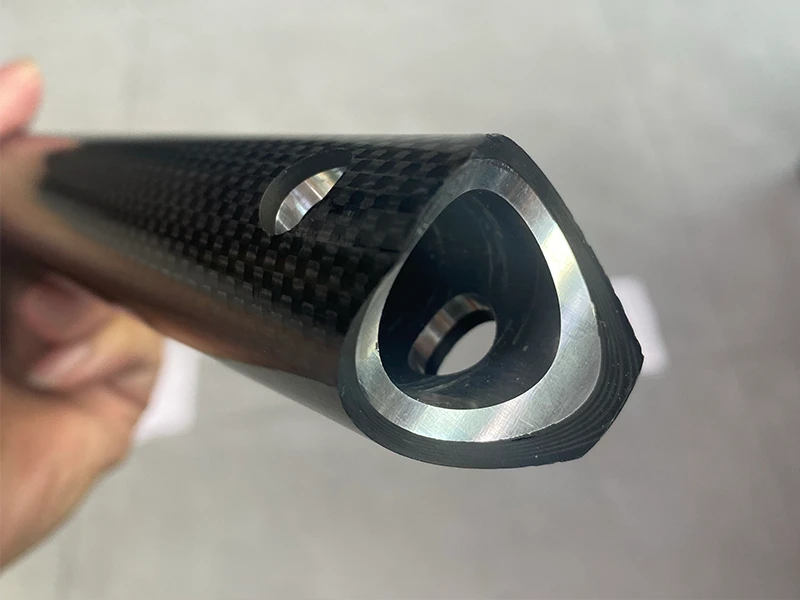
Integrating an inner 6061-T6 alloy liner inside a carbon aluminum bicycle tube solves these mechanical limitations permanently. Specifically, the ductile aluminum core absorbs high clamp compression. In contrast, the outer high-modulus carbon jacket handles cyclic bending loads. As a result, riders gain maximum lateral stiffness without fearing tube crushing.
Furthermore, this hybrid architecture unlocks true mirror-grade aesthetics. Standard epoxy clear coats often exhibit surface waviness and pinholes. Instead, our factory applies a specialized automotive-grade piano mirror lacquer. Therefore, the cured composite displays dramatic 3D visual depth and superior UV degradation resistance.
Performance Comparison: Pure Carbon vs. Aluminum vs. Hybrid Tubing
Analyzing structural materials highlights why co-molded hybrid tubing provides distinct design advantages:
| Material Architecture | Point-Load Resistance | Direct Threading Capability | Frame Application Verdict |
|---|---|---|---|
| Pure Carbon Fiber | Low (Vulnerable to clamping crush) | Impossible (Requires glued metal inserts) | Ultra-light for race day, but fragile during daily hardware maintenance. |
| 6061-T6 Aluminum | High (Ductile yield under load) | Direct tapping and drilling ready | Durable and easy to assemble, but imposes a severe weight and vibration penalty. |
| Carbon-Aluminum Hybrid | Maximum (Metallic hoop containment) | Fully machinable and threaded | Optimal balance for aero seatposts, E-bike down tubes, and gravel frames. |
DFM Rules for Machining and Aerodynamic Profiling
Designing composite bicycle tubes requires precise mechanical planning. Specifically, engineering teams should evaluate three vital manufacturing disciplines:
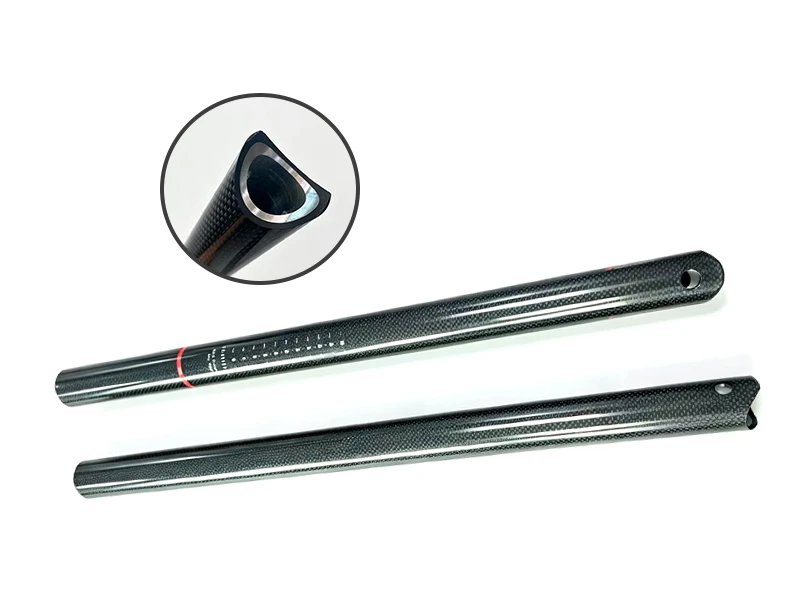
1. Aerodynamic D-Shape Geometry: Round tubes generate turbulent wake behind the seatpost. In contrast, a truncated D-shape airfoil slices wind smoothly. In addition, the flat rear face prevents the seatpost from rotating out of alignment. Therefore, mechanics never have to re-straighten tilted saddles after rough rides.
2. Preventing Galvanic Corrosion: Direct contact between graphite fibers and aluminum can spark galvanic reaction. However, our manufacturing process introduces a non-conductive epoxy isolation barrier during consolidation. Consequently, the metal core remains fully shielded against moisture ingress and electrochemical degradation.
3. One-Stop CNC Post-Drilling: Routing holes through metal and composite together requires specialized tooling. Traditional drill bits cause fiber breakout at the interface. Therefore, YTCarbon utilizes custom multi-axis CNC routing to machine internal cable ports and bottle cage positions within ±0.1mm tolerance. This turnkey capability guarantees factory-finished custom CNC machined parts without delamination.
Frequently Asked Questions
About the Author: Ken & YTCarbon Engineering Team
Ken serves as General Manager and Technical Director at YTCarbon (Shenzhen Yuantan New Materials Technology Co., Ltd.). With more than a decade of composite manufacturing experience, he specializes in high-pressure thermal co-molding, multi-axis diamond CNC routing, and surface finishing technologies. Furthermore, his engineering team develops lightweight structural carbon components for international cycling brands, drone developers, and industrial robotics manufacturers.