How to Prevent Delamination When CNC Machining Carbon Fiber Sheets
A practical Design for Manufacturability (DFM) engineering guide on eliminating peel-up, push-out burrs, and tool burnout when routing high-precision composite structural components.
Understanding Peel-Up vs. Push-Out Mechanics
Unlike isotropic metals that yield continuous ductile chips, carbon fiber reinforced polymers (CFRP) are anisotropic and highly abrasive. When a rotating CNC cutting edge strikes the heterogeneous matrix of rigid graphite fibers and crosslinked resin, improper cutting forces easily overcome the interlaminar shear strength, causing structural ply separation.
Peel-up delamination occurs at the top entry face when upward cutting vectors lift unrestrained surface fibers. Conversely, push-out delamination occurs at the bottom exit when downward axial thrust punches through the thinning laminate before shearing the fibers. Eliminating both requires precise tool geometries that equalize internal laminate stress.
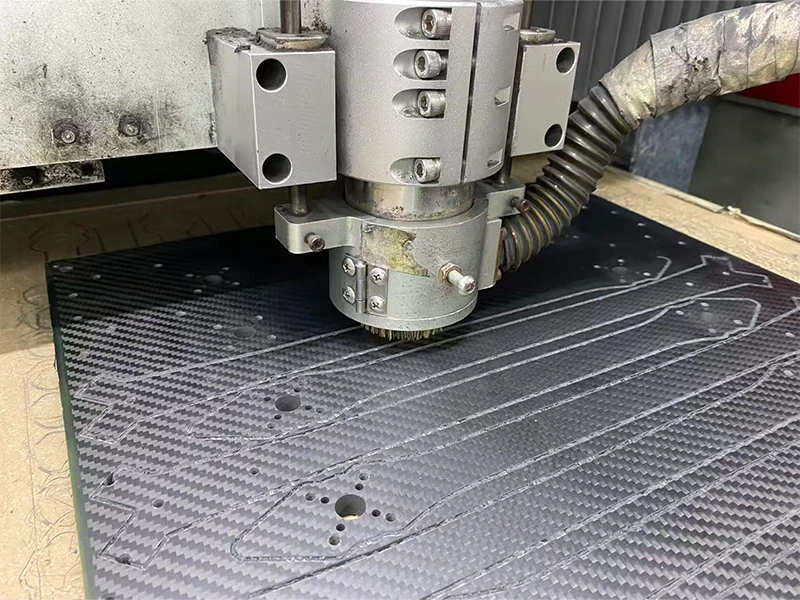
The Gold Standard: Dual-Helix Compression Cutters
Machining structural plates with conventional spiral end mills invariably leads to edge fraying or rapid tool dulling. As cutting edges dull, rubbing replaces shearing, generating frictional heat that exceeds the epoxy resin’s glass transition temperature (Tg) and accelerating thermal failure.
For thick composite stocks such as 4mm carbon fiber sheet and 5mm carbon fiber sheet, the premier solution is CVD diamond-coated compression router bits. These cutters feature opposing helices:
- Up-cut bottom flutes pull cutting forces upward from the bottom face toward the center.
- Down-cut top flutes force cutting vectors downward from the top face toward the core.
- Active Compression: By sandwiching the boundary plies under active inward compression, edge breakout is physically neutralized.
Tooling Substrate & Machining Performance Comparison
Selecting the appropriate cutting tool grade is paramount to preserving edge sharpness, maintaining tight tolerances, and avoiding catastrophic ply delamination:
| Tooling Type | Wear Resistance | Delamination Risk | Engineering Verdict |
|---|---|---|---|
| Standard Carbide | Dulls rapidly (<15 mins in pure carbon) | High (Severe breakout once dulled) | Low-cost rough prototyping only; scrap risk is excessive. |
| DLC (Diamond-Like) | High (Low friction, moderate abrasion life) | Moderate (Safe on thin sheets) | Excellent for high-speed perimeter profiling on 1mm–2mm plates. |
| CVD Diamond-Coated | 12×–15× life over standard carbide | Very Low (Sharp edge retention) | Factory baseline at YTCarbon for production CNC milling. |
| PCD (Polycrystalline) | Maximum industrial endurance | Negligible (Zero burr generation) | Dedicated high-volume aerospace and automotive nesting lines. |
Best Practices for Drilling, Countersinking, and Vacuum Fixturing
Achieving aerospace-grade edges across CNC machined carbon fiber parts and carbon fiber jig & fixtures requires strict execution of three core operational disciplines:
1. Kinematics & Chip Load: Do not “rub” the laminate. Maintain a chip load between 0.03mm and 0.08mm per tooth at 12,000–20,000 RPM. A robust chip load evacuates heat along with particulate chips rather than baking heat directly into the epoxy matrix. Always adopt shallow helical or 1°–2° ramping plunges instead of straight Z-axis vertical drops.
2. Precision Countersinking & Drilling: Replace 118° twist drills with specialized dagger or candlestick drills featuring razor-sharp outer scoring spurs that slice fiber margins before center breakthrough. For deep M3/M4 flush countersinks, use interpolated circular milling with diamond end mills to direct forces radially rather than vertically downwards.
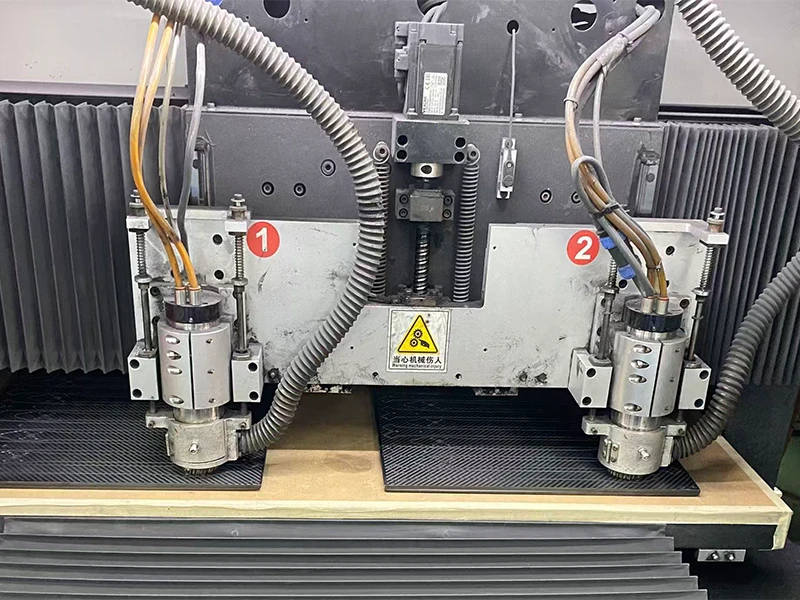
3. High-Vacuum Bed Fixturing & Dust Containment: Unsupported sheet spans generate harmonic flutter that chips cutter edges and tears plies. Multi-zone vacuum beds distribute uniform hold-down across massive panels. Furthermore, spark-free localized extraction with Class H HEPA filtration protects spindle electronics from abrasive, conductive carbon airborne dust.
Frequently Asked Questions
About the Author: Ken & YTCarbon Engineering Team
Ken is the General Manager and Technical Lead at YTCarbon (Shenzhen Yuantan New Materials Technology Co., Ltd.). Backed by over a decade of production expertise in composite hydraulic hot-pressing, compression molding, and spark-free diamond CNC routing, our engineering team provides turnkey DFM solutions, high-tolerance machining (±0.05mm), and structural composite manufacturing for global robotics, drone, and industrial automation clients.