Carbon Fiber Tent Pole vs Aluminum: Which Is Better?
Your tent poles take more abuse than any other component in your shelter — wind, rain, repeated setup, and rough handling. For decades, aluminum has been the default. But carbon fiber tent poles are changing the math: 70% lighter, corrosion-proof, and they flex back instead of bending permanently. Here is a head-to-head comparison to help you decide.
Why Tent Pole Material Matters
A tent pole does one job: hold your shelter up against wind, rain, and snow. Yet most campers never think about pole material until a pole fails — usually at 2 AM in a storm, when a bent aluminum pole turns your tent into a collapsed mess. The material your poles are made from directly determines three things: weight in your pack, durability in the field, and how the pole fails when pushed past its limit.
Aluminum tent poles — typically 7001-series or DAC aluminum — have served the outdoor industry well for decades. They are affordable, widely available, and reasonably strong. However, they carry a weight penalty that adds up fast: a typical 4-person tent uses 6 poles, and swapping aluminum for carbon fiber saves over 300 grams. For thru-hikers and ultralight backpackers, that is significant.
Carbon fiber tent poles, by contrast, weigh approximately one-third of equivalent aluminum poles while delivering higher specific strength. The key difference is not just weight — it is how the material behaves under stress. Aluminum bends permanently past its yield point. Carbon fiber flexes and returns to shape. This single property changes the entire user experience in the field.
Weight: 70% Reduction Is Not Marketing — It Is Math
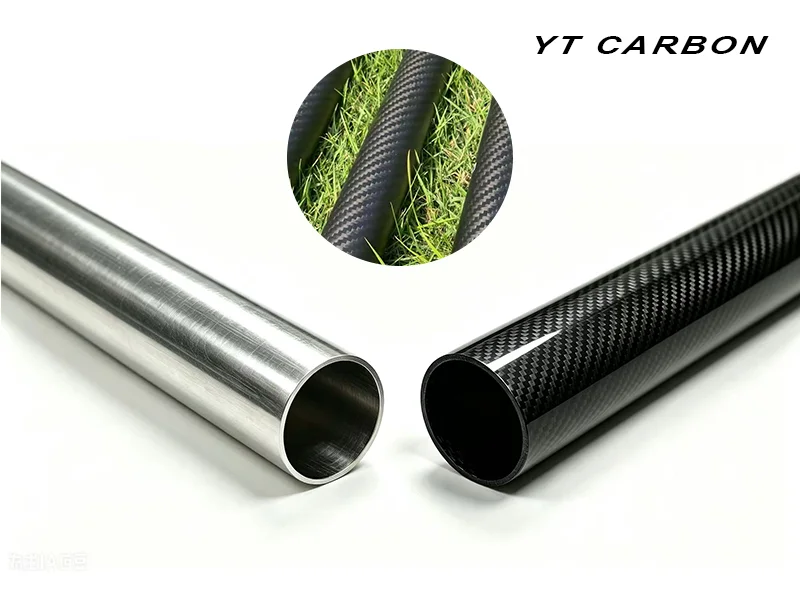
Let us put real numbers on it. A standard 8.5mm aluminum tent pole weighs approximately 12–14 grams per meter. A carbon fiber tent pole of the same diameter weighs 4–5 grams per meter. That is roughly a 70% weight reduction — not a marginal improvement, but a category-level change.
For a concrete example, consider a popular 4-season tent with six 8.5mm poles, each 120cm long. The aluminum poles weigh approximately 85g each, totaling 510g. Switching to carbon fiber tent poles at 25g each drops the total to 150g — saving 360g. That is more weight than many campers save by switching to a titanium stove or an ultralight sleeping pad combined.
For ultralight backpackers counting every gram, a lightweight tent pole replacement is one of the highest-ROI upgrades available. Unlike swapping a tent body for a lighter fabric — which may sacrifice weather protection — swapping poles reduces weight without compromising shelter integrity.
Property Comparison Table
| Property | Aluminum | Carbon Fiber |
|---|---|---|
| Weight (8.5mm × 1m) | ~12–14 g | ~4–5 g (70% lighter) |
| Failure Mode | Permanent bend | Flexes and returns to shape |
| Corrosion Resistance | Poor — oxidizes in salt air | Excellent — no rust or oxidation |
| Flexural Strength | Good | Higher (specific strength) |
| Temperature Sensitivity | Conducts cold to hands | Low thermal conductivity |
| Impact Resistance | Dents but still functional | Avoid sharp point impacts |
| Upfront Cost | Low | Higher |
| Lifespan in Wet Conditions | 3–5 years before corrosion | Indefinite — no corrosion |
| Best For | Budget camping, casual use | Ultralight, long-distance, marine |
Failure Mode: Bend vs Flex
This is the single most important difference between aluminum and carbon fiber tent poles — and it affects real-world usability more than any spec sheet number.
Aluminum bends permanently. When an aluminum pole is pushed past its yield strength — by a strong wind gust, a misplaced elbow during setup, or snow load — it deforms and stays bent. A bent pole still works, sort of, but it creates a weak point that will bend further at the same spot. Eventually, repeated bending at the kink leads to work-hardening and snapping. Every backpacker has experienced this: the dreaded midnight pole collapse in a storm.
Carbon fiber flexes and returns. A carbon fiber tent pole under the same load flexes into an arc and snaps back to straight when the load is removed. There is no yield point in the traditional sense — the pole behaves elastically across its entire usable range. This means a wind gust that would permanently bend an aluminum pole leaves a carbon fiber pole completely unaffected.
However, this does not mean carbon fiber is indestructible. Sharp point impacts — stepping on a pole, clamping it in a car door, or striking it against a rock — can cause localized damage. Carbon fiber tent poles should be treated with the same care as any quality gear: avoid crushing and point impacts, and they will outlast aluminum by years.
Corrosion: Salt, Rain, and Humidity
Aluminum tent poles corrode. It is a slow process, but it is inevitable — especially in marine environments, tropical humidity, or extended trips where poles stay wet for days. The corrosion typically starts at the ferrule joints, where dissimilar metals (aluminum pole, steel or brass ferrule) create a galvanic cell. Once corrosion takes hold, joints become stiff, difficult to assemble, and eventually seize completely.
Carbon fiber tent poles do not corrode — period. Carbon fiber is chemically inert in the conditions tents face: rain, salt spray, UV exposure, and humidity. The ferrule joints can be specified in aluminum or carbon sleeves, and even with aluminum ferrules, the reduced metal-to-metal contact area minimizes galvanic risk compared to full aluminum poles.
For coastal camping, sea kayaking expeditions, or tropical treks where gear stays wet for weeks, carbon fiber tent poles eliminate a maintenance burden that aluminum cannot avoid. No rinsing, no drying, no anti-corrosion spray — just pack and go.
Pultruded Construction: Strength Where Poles Need It
Not all carbon fiber tubes are made the same way. Tent poles require maximum bending resistance along their length — and that is exactly what the pultrusion process delivers. In pultrusion, continuous carbon fibers are pulled through a heated die, aligning every fiber along the tube axis (0° direction). This creates a tube with all its strength concentrated in the direction tent poles actually flex.
By contrast, roll-wrapped tubes use multi-directional fiber layup (0°/90° or 0°/±45°/90°), which spreads strength across multiple axes. While this is ideal for drone frames and structural components facing multi-directional loads, it is less efficient for tent poles where the load is almost entirely unidirectional bending.
Pultruded carbon fiber tent poles also offer cost advantages. The continuous manufacturing process is highly efficient, producing consistent quality at lower cost than roll-wrapped construction. For OEM tent manufacturers ordering in bulk, this makes carbon fiber tent poles a viable upgrade option rather than a premium luxury.
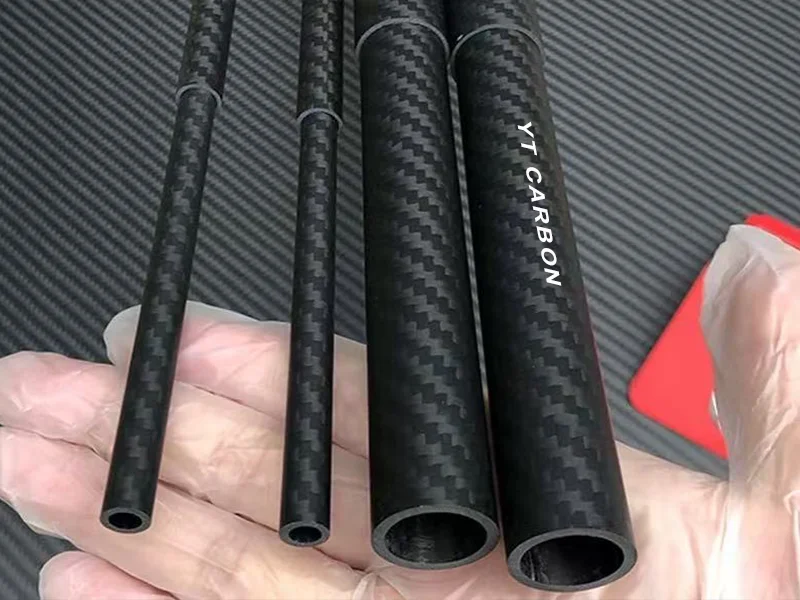
At YTCarbon, we manufacture pultruded carbon fiber tent poles in diameters from 6mm to 12mm with wall thicknesses from 0.5mm to 1.5mm. Every pole is cut to your exact length, with precision ferrule joints and optional shock-cord assembly — making them direct replacements for factory aluminum poles or custom components for new shelter designs.
Frequently Asked Questions
Upgrade Your Tent Poles to Carbon Fiber
Custom diameters, lengths, and ferrule joints. Factory-direct from Shenzhen. Get a tailored quote within 24 hours.