Carbon Fiber Sheet Cutting Methods: CNC vs Waterjet vs Laser
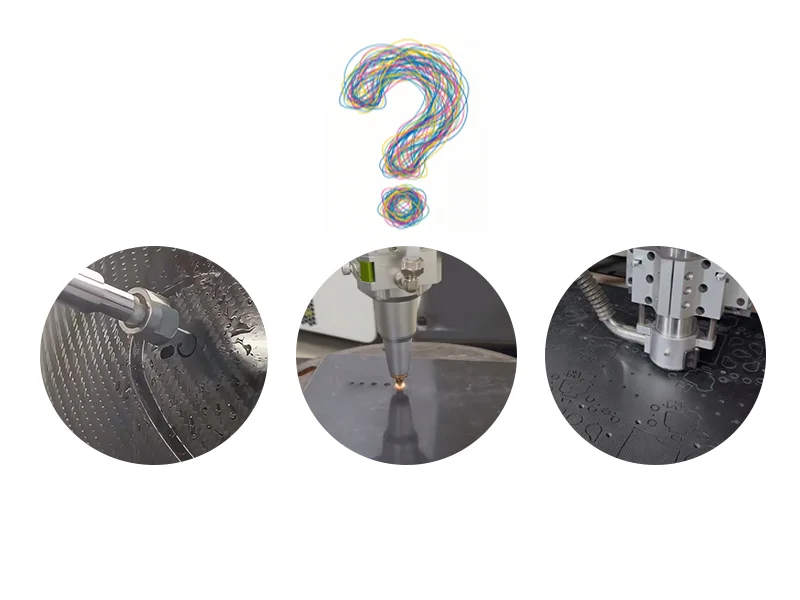
The way you cut a carbon fiber sheet matters as much as the sheet itself. Each cutting method — CNC routing, waterjet, and laser — produces different edge quality, tolerances, and thermal effects. Choose wrong, and you get delamination, fiber pull-out, or heat-damaged edges. Here is how the three methods compare, and when to use each one.
Why Cutting Method Matters
First of all, the cutting method you choose for a carbon fiber sheet directly affects four critical outcomes: edge quality, dimensional tolerance, heat-affected zone, and overall processing cost. Furthermore, carbon fiber reinforced polymer (CFRP) is an anisotropic material — its fiber orientation determines how it responds to cutting forces. A tool traveling parallel to the fibers produces a different finish than one cutting across them.
Therefore, selecting the wrong cutting method can lead to serious defects. Delamination occurs when cutting forces exceed the interlaminar bond strength, causing layers to separate. Fiber pull-out happens when individual fibers are yanked from the matrix instead of being cleanly severed. In addition, thermal methods can degrade the epoxy resin, leaving a brittle, charred edge that compromises structural integrity.
Consequently, the decision between CNC routing, waterjet cutting, and laser cutting should never be an afterthought. Moreover, factors like sheet thickness, required tolerance, production volume, and budget all play a role. Below, we walk through each method in detail so you can make an informed choice for your next carbon fiber sheet cutting project.
CNC Routing — Precision and Versatility
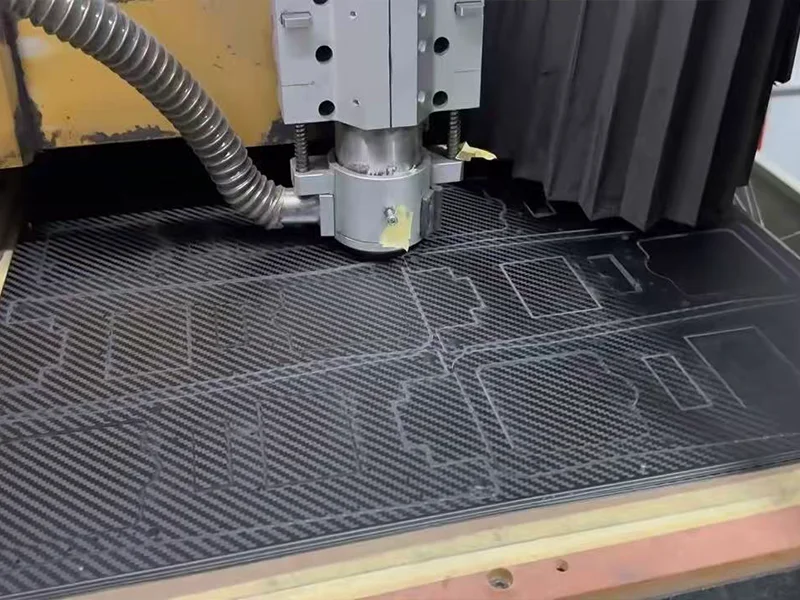
To start, CNC routing uses a high-speed rotating cutting tool that follows a programmed toolpath to remove material from the carbon fiber sheet. Specifically, diamond-coated or carbide end mills shear through both the fiber and the resin matrix in a single pass. The spindle speed, feed rate, and number of flutes all influence the final edge quality.
Additionally, CNC routing offers several key advantages. It achieves tight tolerances of ±0.1 mm, which is critical for structural assemblies and precision-fit components. The edges come off the machine clean and ready for secondary finishing, with no heat-affected zone. Furthermore, CNC machines can perform chamfering, countersinking, and pocket milling in a single setup, making them extremely versatile for complex geometries.
However, there are drawbacks to consider. Tool wear is significant — carbon fiber is highly abrasive, and even diamond-coated bits degrade over time. Additionally, the cutting process generates fine carbon dust that must be managed with effective dust extraction. Speed is moderate compared to laser cutting, especially for thicker sheets. Therefore, CNC routing is best suited for structural parts, CNC carbon fiber sheet applications, and precision assemblies where tight tolerances and clean edges are non-negotiable.
Waterjet Cutting — Cold and Clean
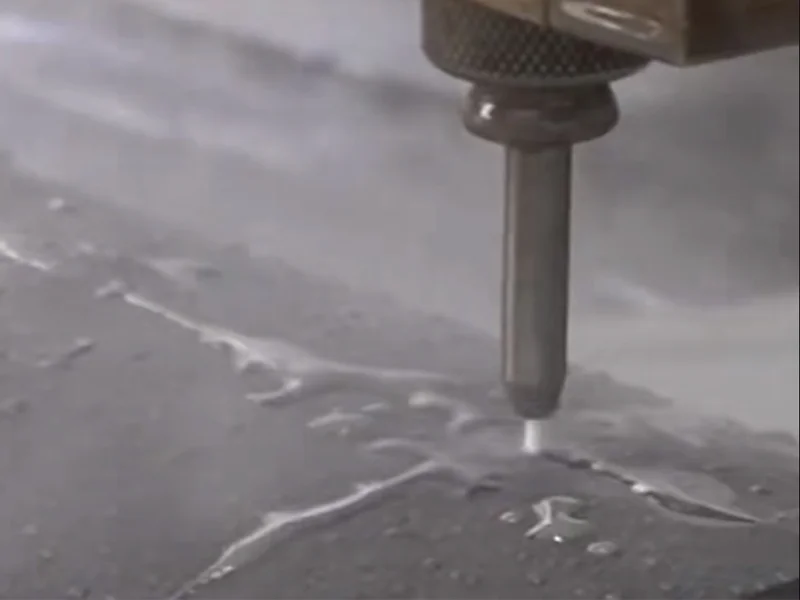
In contrast to mechanical and thermal methods, waterjet cutting uses a stream of water pressurized to 60,000–90,000 PSI mixed with abrasive particles to erode the material. Moreover, because the process is entirely cold, there is zero heat-affected zone — the epoxy resin and fiber matrix remain completely intact. This makes waterjet cutting uniquely suitable for applications where thermal degradation is unacceptable.
Meanwhile, waterjet cutting excels at handling very thick materials. It can comfortably cut carbon fiber sheets up to 120 mm thick, far beyond the practical limits of CNC routing and laser cutting. Furthermore, the edges produced are free from charring, melting, or fiber recession, which is critical for fire-retardant laminates and high-temperature composites.
However, waterjet cutting has its limitations. First, moisture can penetrate the cut edges, especially on unsealed laminates — this requires post-cut edge sealing to prevent long-term degradation. Second, the tolerance is generally ±0.25 mm, looser than CNC routing. Additionally, consumable costs make waterjet one of the more expensive cutting methods per part. Therefore, waterjet cutting is most appropriate for ultra-thick sheets, fire-retardant panels, and applications where heat exposure must be completely avoided.
Laser Cutting — Fast but Limited
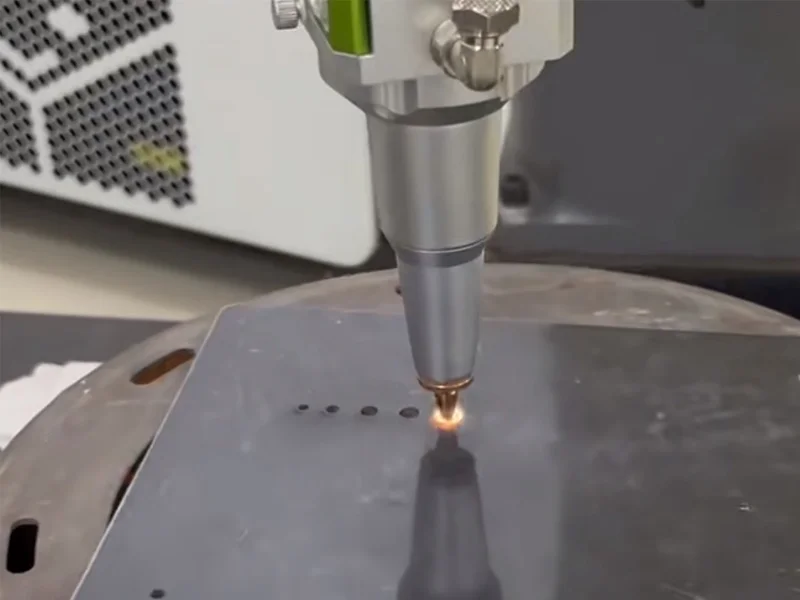
Finally, laser cutting uses a focused high-energy beam to vaporize the carbon fiber and resin along the cutting path. Namely, the beam moves at high speed, and because there is no physical tool contact, there is zero mechanical force on the workpiece. This non-contact nature eliminates the risk of delamination from cutting forces.
Furthermore, laser cutting is the fastest of the three methods for thin sheets. The kerf width is extremely narrow (as low as 0.1 mm), which allows for very fine detail work and tight nesting of parts to minimize material waste. Additionally, the lack of tool wear means consistent cutting quality throughout a production run.
However, laser cutting has significant drawbacks. The most serious issue is the heat-affected zone (HAZ). The intense heat can char the epoxy resin and cause delamination at the cut edges, which may appear brown or black and become brittle. Furthermore, laser cutting is only practical for thin sheets — typically ≤5 mm. Beyond this thickness, multiple passes are needed and thermal damage compounds. Additionally, the vaporization produces odorous fumes requiring ventilation. Consequently, laser cutting is best reserved for thin sheet rapid cutting, prototypes, and decorative components.
Cutting Methods at a Glance
| Property | CNC Routing | Waterjet | Laser |
|---|---|---|---|
| Tolerance | ±0.1 mm | ±0.25 mm | ±0.2 mm |
| Edge Quality | Excellent | Good | Fair (HAZ) |
| Heat Affected Zone | None | None | Significant |
| Max Thickness | ~25 mm | 120 mm+ | ≤5 mm |
| Speed | Moderate | Moderate | Fast (thin) |
| Cost | Moderate | High | Low–Moderate |
| Best For | Precision parts | Thick / heat-sensitive | Thin / decorative |
| Dust / Fumes | Fine dust | Wet slurry | Toxic fumes |
How to Choose the Right Method
Ultimately, the best carbon fiber sheet cutting method depends on three key factors: precision, thickness, and budget.
Precision: First, if your parts require tolerances tighter than ±0.15 mm — CNC routing is the clear winner. Its mechanical cutting action delivers the most consistent dimensional accuracy.
Thickness: Second, for sheets under 5 mm, all three methods are viable. For 5–25 mm, CNC and waterjet. For anything thicker — waterjet is the only practical choice. Furthermore, for fire-retardant laminates, the zero-heat advantage of waterjet becomes decisive.
Budget: Finally, CNC routing offers the best balance of cost and quality for most mid-thickness parts. Waterjet handles extreme thicknesses. Laser is cheapest for thin sheets and fast prototyping. See our CNC carbon fiber sheet range →
Frequently Asked Questions
Cutting Methods & Quality
Ordering & Processing
Need Precision Carbon Fiber Sheet Cutting?
CNC routing to ±0.1mm tolerance, cold abrasive waterjet cutting, and rapid prototyping. Send us your CAD drawings (DXF/STEP) for an instant quotation within 24 hours.