Twill vs Plain Weave Carbon Fiber: Which One Do You Need?
When engineers source carbon fiber weave patterns, one question comes up almost every time: twill or plain weave? The answer carries real consequences for your manufacturing process, final product performance, and even your budget. Here is how to decide — with the numbers that matter.
What Exactly Is a Weave pattern?
In 3K carbon fiber weave materials, the carbon fiber tows — bundles of thousands of individual carbon filaments — are interlaced according to specific geometric rules. Specifically, this interlacing creates the fabric structure that gives carbon fiber its form and many of its mechanical properties. Plain weave and twill weave represent the two most common patterns you will encounter in industrial and commercial carbon fiber applications.
The difference lies in how the warp (lengthwise) and weft (crosswise) fibers cross over each other. Namely, plain weave carbon fiber sheet material uses a 1×1 over-under interlacing pattern — each warp fiber alternates over and under each weft fiber, creating a tight, checkerboard-like texture that is immediately recognizable. This straightforward construction has been the foundation of woven textiles for centuries, and it works remarkably well for many modern applications.
Furthermore, plain weave fabrics tend to be stiffer and more stable than their twill counterparts. The tight interlacing restricts fiber movement during handling and curing, which translates to better dimensional control in your finished parts. Consequently, if you are building flat panels or structural components that need to maintain precise geometry, plain weave often delivers the consistency you need. However, the trade-off is drapability — plain weave fabrics conform less easily to curves and complex shapes.
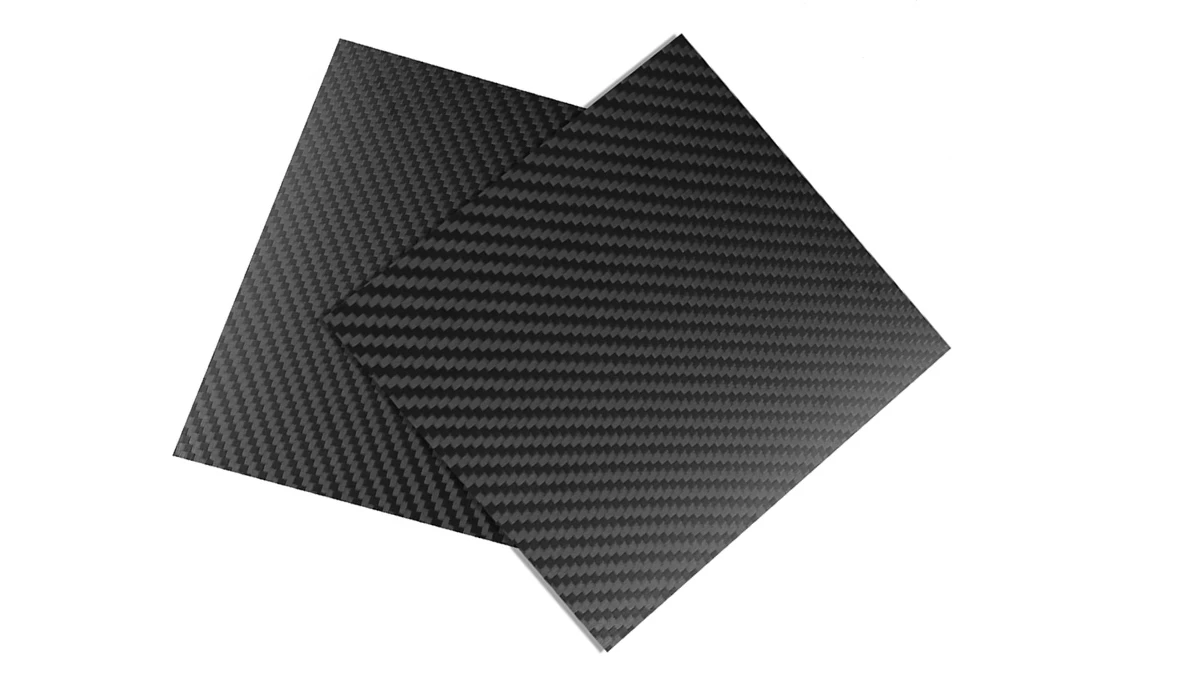
Twill weave creates a distinctive diagonal pattern that many designers find visually striking.
Head-to-Head Comparison
| Specification | Plain Weave (1×1) | Twill Weave (2×2) |
|---|---|---|
| Tensile Strength (T300-3K) | 620 MPa | 580 MPa |
| Flexural Modulus | 32 N·m²/m | 28 N·m²/m |
| Drapeability Factor | 1.0 (baseline) | 1.6 (60% better) |
| Minimum Forming Radius | 100 mm | 50 mm |
| Visual Pattern | Checkerboard / Grid | Diagonal / Herringbone |
| Surface Texture | Uniform, flat appearance | 3D, dimensional feel |
| Best For | Flat panels, structural parts | Curved surfaces, complex shapes |
Twill Weave: Structure and Characteristics
In contrast, twill weave carbon fiber sheet materials use a 2×2 over-under interlacing pattern. Instead of alternating with every crossing, the warp fibers pass over two weft fibers, then under two, creating a diagonal ribbing effect that runs across the fabric face. Consequently, this creates the characteristic “twill lines” that many people associate with high-end carbon fiber products.
The structural difference gives twill weave a notable advantage in drapability and conformability. Moreover, fibers can shift more easily during layup, making it significantly easier to wet out and form over curved surfaces, corners, and complex geometries. Therefore, twill becomes the preferred choice for automotive interior panels, drone frames, sports equipment, and any application where the carbon fiber needs to follow a non-flat contour.
Additionally, the visual appeal of twill weave should not be underestimated. The diagonal pattern creates a more dynamic, three-dimensional appearance that many designers and consumers find more distinctive than the uniform checkerboard of plain weave. In fact, in consumer-facing products where the carbon fiber aesthetic is part of the value proposition, twill is almost always the default choice.
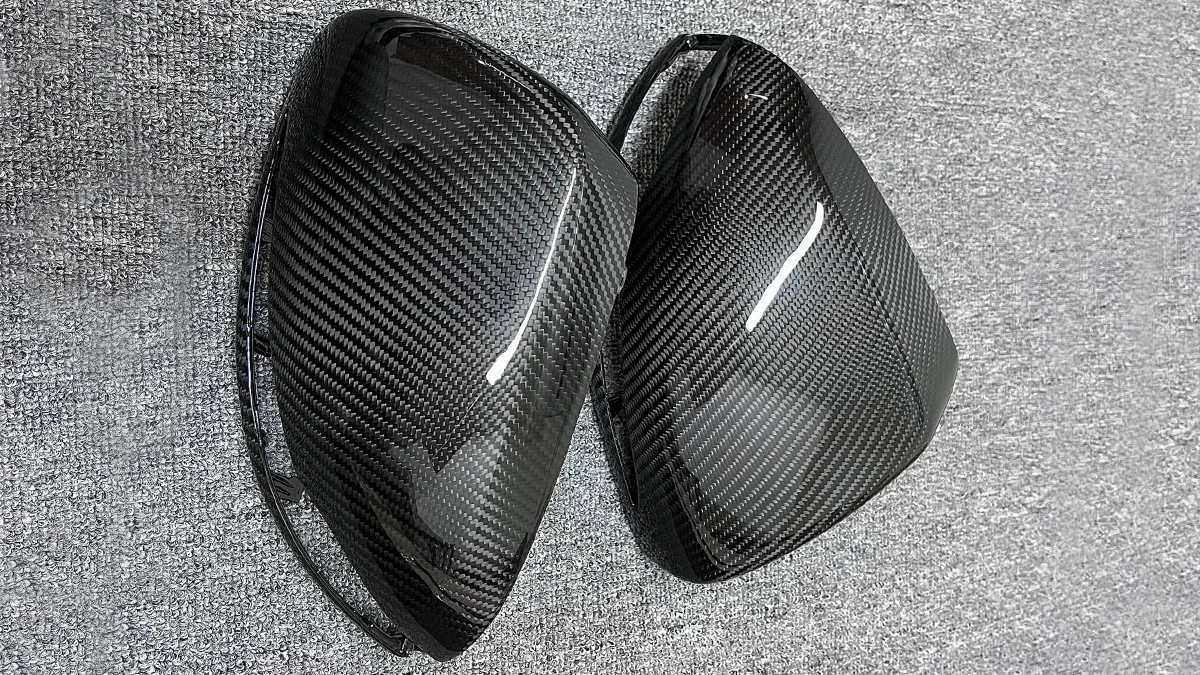
Twill weave carbon fiber conforms easily to curved surfaces in automotive applications.
Application Scenarios: Where Each Weave Shines
Given its higher stiffness and dimensional stability, plain weave is the go-to choice for several demanding scenarios. Namely, structural reinforcement panels in aerospace and marine applications where load-bearing capacity is critical; flat architectural elements such as wall panels and facades requiring precise flatness; industrial equipment housings where consistent thickness affects assembly tolerances; sandwich panel cores in composite structures where the fabric must maintain bond lines without distortion; and electrical insulation panels where uniform surface characteristics support consistent performance. Furthermore, if your project involves CNC machining the finished part, plain weave’s stability makes it easier to predict and control final dimensions.
Conversely, twill weave excels when form takes priority over absolute flatness. For instance, automotive interior trim and exterior panels where curved surfaces are standard design elements; drone frames and RC aircraft components where complex 3D geometry meets weight reduction goals; sports equipment including bicycle components, tennis rackets, and fishing rods; consumer electronics housing where the distinctive twill pattern serves as a visual differentiator; and custom automotive parts like hoods, spoilers, and mirror housings that need to follow curved body contours. Ultimately, the visual impact of twill weave also makes it popular in consumer-facing products where the carbon fiber aesthetic is part of the value proposition.
How to Choose: A Practical Decision Framework
Still not sure which weave pattern fits your project? First, consider the geometry of your part. If it is primarily flat with minimal curves, plain weave is likely your best match. However, if it has radii, corners, or compound curves, twill weave will save you significant headaches during layup.
Second, weigh your priority between strength and aesthetics. Importantly, if maximum tensile and flexural performance are non-negotiable, the slight mechanical advantage of plain weave — about 7% higher tensile strength and 14% higher flexural modulus — may matter. On the other hand, if visual appearance matters as much as performance, twill weave’s 3D pattern effect could be the deciding factor.
Third, evaluate your manufacturing complexity. Notably, if you are hand-laying vacuum-infused parts and want a forgiving fabric that wets out easily, twill weave reduces the skill requirement. Conversely, if you have experience with plain weave, stick with what your team knows. Fourth, consider your finishing requirements — both weaves can be clear-coated or painted, but the surface appearance differs. Plain weave produces a flatter, more consistent surface ideal for high-gloss finishes, whereas twill weave creates subtle depth that some designers prefer for matte or satin finishes.
Ultimately, in many real-world applications, the choice comes down to a simple heuristic: flat parts = plain weave; curved parts = twill weave. Admittedly, that is not a hard rule, but it covers the majority of cases effectively.
Quick Reference: Which Weave for Your Application
Frequently Asked Questions
Need the Right Carbon Fiber Weave for Your Project?
Both plain weave and twill weave carbon fiber sheets in stock. Panel sizes up to 3m × 8m, thicknesses from 0.2mm to 120mm. Standard sheets or custom CNC-machined parts — get a quote within 24 hours.