How Carbon Fiber Sheets Are Made:
From Raw Fiber to Finished Panel
Watching black fabric transform into remarkably strong, lightweight panels at a carbon fiber sheet manufacturing facility, you quickly realize this is no ordinary production line. The process from raw precursor to finished carbon fiber sheet involves a precise sequence of chemical transformation, thermal processing, and mechanical engineering — each step carefully controlled to deliver the strength and stiffness that makes carbon fiber panels indispensable across aerospace, automotive, marine, and industrial applications.
If you have ever asked yourself how carbon fiber sheets are made into the flat, consistent panels used in your designs, this guide breaks down the complete carbon fiber sheet manufacturing process step by step.

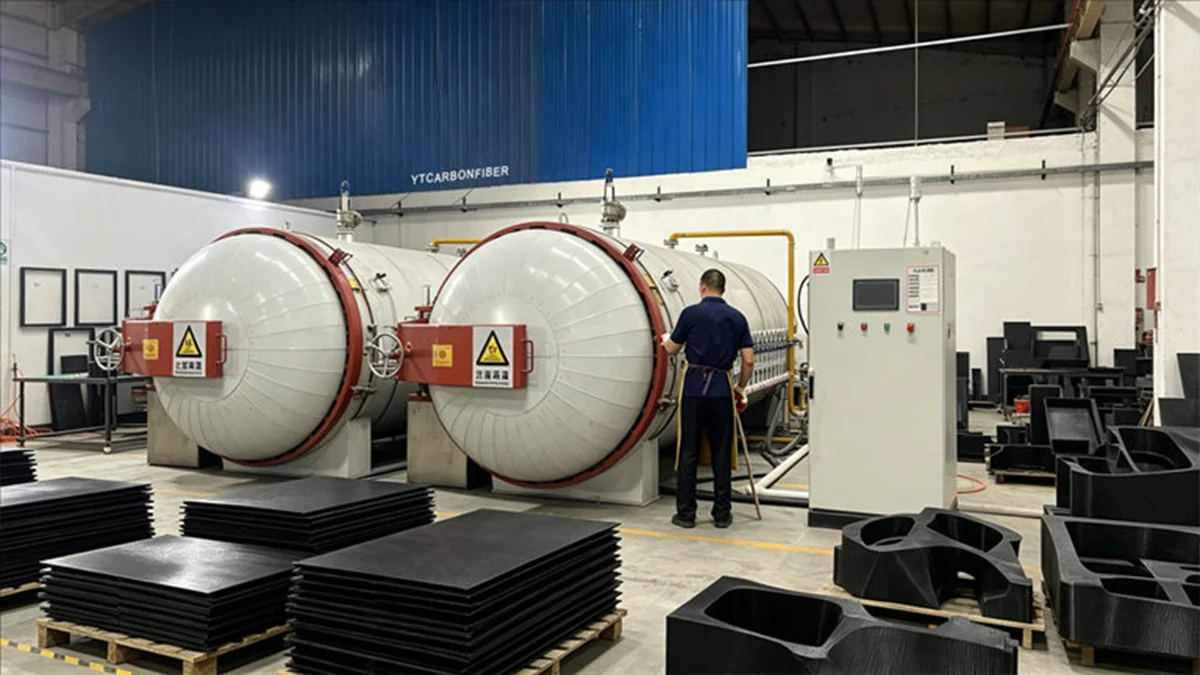
High-temperature carbonization furnace where PAN fibers transform into carbon fibers at 1000–3000°C
The Raw Material: PAN Precursor
Every carbon fiber sheet starts with polyacrylonitrile, known as PAN, which accounts for approximately 90% of all carbon fiber produced worldwide. PAN is a polymer fiber that serves as a precursor — not the final product, but the material that will be chemically transformed through controlled heating. The starting filaments are typically 5 to 10 micrometers in diameter per fiber.
The quality of the PAN precursor directly affects the mechanical properties of finished carbon fiber panels. Aerospace-grade sheets use high-purity PAN formulated for maximum tensile strength, while industrial carbon fiber sheet production may optimize for cost efficiency rather than peak performance. Either way, the precursor must be converted into nearly pure carbon before it becomes useful as a structural material.
Carbonization: Where the Magic Happens
Carbonization is the core of carbon fiber sheet manufacturing. During this step, stabilized PAN fibers are heated to extreme temperatures in controlled atmospheres to drive off all non-carbon atoms. The process follows two stages: low-temperature carbonization between 300°C and 600°C, then high-temperature treatment from 1000°C to 3000°C. Temperature profiles and dwell times vary between manufacturers and directly determine whether the resulting panel achieves high tensile strength, high modulus, or a balanced combination.
Furnace atmospheres are carefully controlled using inert gases such as nitrogen or argon to prevent combustion at these extreme temperatures. As temperature rises, hydrogen, nitrogen, and oxygen atoms are progressively removed from the PAN molecular chains. What remains is a carbon structure organized into graphitic crystallites — giving carbon fiber its legendary strength-to-weight ratio. A single filament can be hundreds of times stronger than steel by weight, yet roughly five times lighter.
Following carbonization, fibers undergo surface treatment — typically electrolytic oxidation in an acidic bath — to increase surface roughness and improve bonding with the resin matrix. A sizing coating, usually epoxy-based, is then applied to protect fiber bundles during handling, weaving, and composite manufacturing.

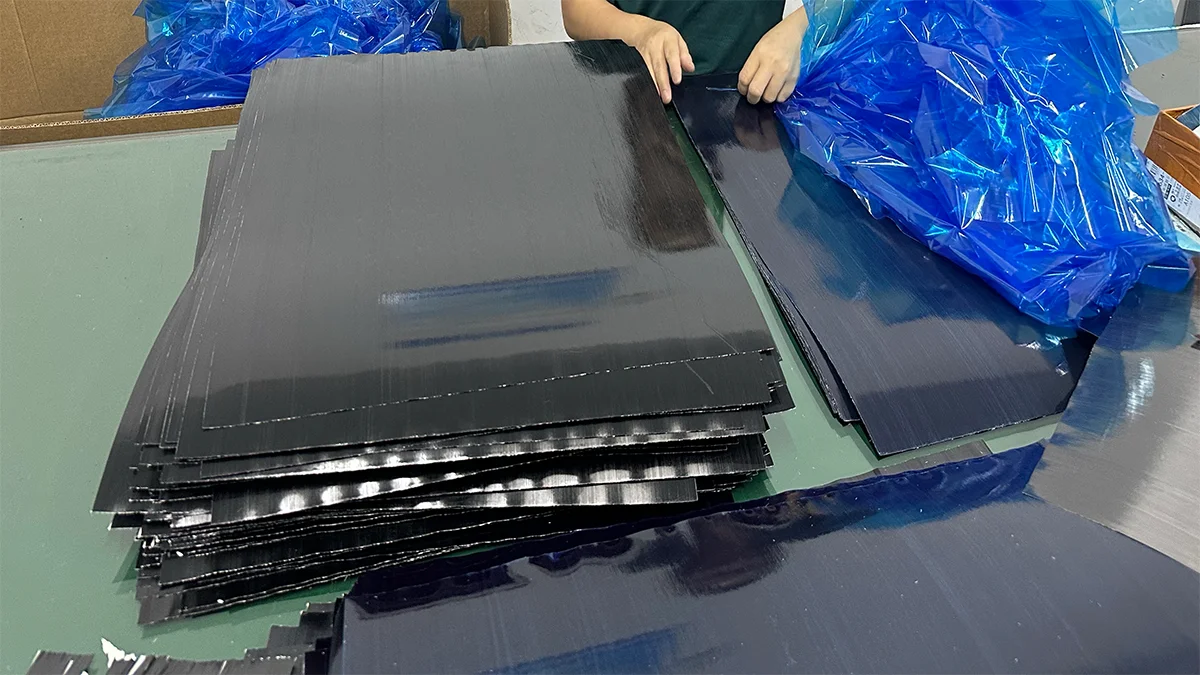
Precision prepreg layup — each layer is carefully oriented to achieve target mechanical properties
Weaving: From Fiber to Fabric
Carbonized and sized fibers are gathered into bundles called tows, denoted by filament count. A 3K tow contains 3,000 filaments; 12K has 12,000. Smaller tows like 1K and 3K create finer, more flexible fabrics suited for curved surfaces. Larger tows such as 12K and 24K produce thicker, stiffer panels for maximum structural performance.
These tows are woven into fabric using different patterns. Plain weave offers stability and good handling. Twill weave produces a diagonal pattern with better drapeability for gently curved panels. Unidirectional (UD) fabric aligns all fibers in one direction for maximum stiffness along that axis. Biaxial and multiaxial non-crimp fabrics layer fibers at multiple orientations to achieve quasi-isotropic stiffness distribution across the sheet.
Prepreg and Resin Systems
Prepreg refers to carbon fiber fabric that has been pre-impregnated with a controlled amount of resin — typically epoxy, though vinyl ester and polyester are also used depending on requirements. In carbon fiber sheet manufacturing, prepreg is the building block that will be stacked, oriented, and cured into the final panel. Resin content typically ranges from 30% to 42% by weight, with fiber volume fraction targeted at 65% or higher for structural-grade sheets.
Different resin systems serve different applications. Epoxy is the most widely used for structural carbon fiber panels, offering excellent mechanical properties and low shrinkage. Vinyl ester provides superior chemical and corrosion resistance — ideal for marine and industrial carbon fiber sheets. Polyester is the most cost-effective option, suitable for decorative and non-structural panels.
Layup: Building the Composite Stack
During layup, individual prepreg plies are cut and stacked in precise orientations defined by the mechanical requirements of the finished carbon fiber sheet. Layer orientation — measured relative to the primary load direction — determines panel behavior under stress. Common sequences include:
- Unidirectional: All fibers aligned in one direction for maximum stiffness in that orientation
- Cross-ply: Alternating 0° and 90° orientations for balanced properties
- Quasi-isotropic: Layers at 0°, 90°, +45°, and -45° for balanced properties in all in-plane directions
- Custom sequences: Engineered for specific directional stiffness requirements
Panel thickness is determined by the number of plies stacked. Thin sheets for covering and cosmetic applications may use 2 to 6 plies (0.3mm to 1.0mm thickness). Structural plates for load-bearing applications can stack 20 or more plies for thicknesses of 5mm, 10mm, or beyond. Advanced manufacturing techniques can produce ultra-thin carbon fiber sheets as thin as 0.2mm, while specialized facilities handle large-format panels up to 3 meters wide and 8 meters long.
Curing: Transforming Soft Stack into Solid Panel
The stacked prepreg must be consolidated and cured to form a solid, void-free carbon fiber sheet. Heat and pressure melt the resin, consolidate the plies, and allow the matrix to harden around the carbon fibers.
| Curing Method | Best For | Pros | Cons |
|---|---|---|---|
| Hot Press Molding | High-volume flat sheets (0.3–10mm) | Fast cycle, cost-effective, consistent | Flat or lightly curved only |
| Autoclave Curing | Aerospace-grade panels | Lowest void content, highest quality | Slow, high equipment cost |
| Vacuum Bag Only | Custom and prototype panels | Low tooling cost, one-off capable | Higher void content |
| Continuous Lamination | Thin sheets in long lengths | High output, consistent thickness | Thin sheets only, fixed widths |
CNC Machining: Finishing the Panel
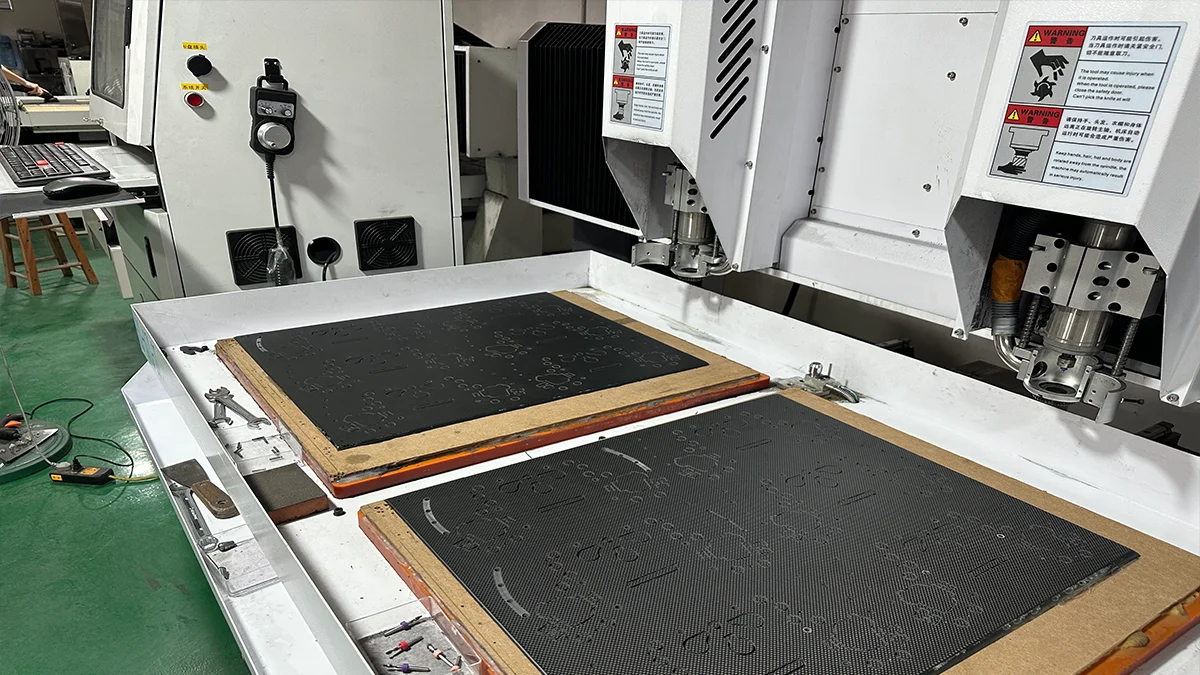
Cured carbon fiber sheets are rarely ready for direct use. CNC post-processing is an essential step in carbon fiber panel fabrication that transforms raw panels into finished parts. Common operations include precision cutting to final dimensions, drilling holes for fasteners and connectors, routing pockets and channels, and edge finishing to achieve clean, sealed borders that resist delamination.
CNC machining of carbon fiber sheets requires specialized tooling and parameters that differ significantly from metalworking. Carbon fiber is abrasive and highly anisotropic — it cuts differently along the fiber direction versus across it. Using incorrect parameters causes delamination, where individual plies separate and compromise structural integrity. High spindle speeds (15,000 to 30,000 RPM), sharp polycrystalline diamond (PCD) or carbide tools, and controlled feed rates minimize heat generation and prevent edge defects.
Quality Assurance: Testing Every Batch
Reputable manufacturers implement quality control throughout carbon fiber sheet production. Incoming inspection verifies prepreg resin content and fiber areal weight. Process monitoring tracks cure temperature and pressure profiles. Finished panel inspection includes visual examination, dimensional measurement, ultrasonic or X-ray inspection for internal voids and delaminations, and mechanical testing of sample coupons.
| Quality Parameter | Typical Specification | Test Method |
|---|---|---|
| Tensile Strength | 600 – 3500 MPa | ASTM D3039 |
| Flexural Modulus | 60 – 400 GPa | ASTM D790 |
| Thickness Tolerance | ±0.05mm to ±0.15mm | Digital micrometer |
| Void Content | <2% aerospace / <5% industrial | ASTM D2734 |
Frequently Asked Questions
What is the difference between carbon fiber sheets, plates, and panels?
Industry conventions generally classify carbon fiber sheets (0.3mm to 2mm, cosmetic and covering applications), carbon fiber plates (2mm to 10mm+, structural load-bearing), and carbon fiber panels (custom-sized, often large-format for enclosures and architectural elements). All are produced through the same fundamental manufacturing process, with thickness and dimensions controlled by ply count, tooling, and post-processing.
How long does the carbon fiber sheet production process take?
A flat carbon fiber sheet cured in a hot press completes layup and cure in 2 to 4 hours. Autoclave curing for aerospace-grade panels takes 8 to 12 hours per batch. CNC post-processing adds 30 minutes to several hours depending on complexity. Overall lead times range from 1–3 weeks for standard panels and 4–8 weeks for large custom panels.
Can carbon fiber sheets be made in custom sizes?
Yes. Custom carbon fiber sheet manufacturing can accommodate dimensions from small precision-cut pieces to large-format panels up to 3 meters by 8 meters. Custom thicknesses range from as thin as 0.2mm for ultra-lightweight applications up to 25mm+ for heavy structural plates.
Why do some carbon fiber sheets delaminate during machining?
Delamination occurs when cutting forces exceed the interlaminar bond strength between adjacent plies. Common causes include dull tooling, incorrect cutting parameters, improper tool geometry for composites, and inadequate backing support during drilling. Using sharp PCD or solid carbide tooling designed for carbon fiber composites, maintaining appropriate spindle speeds and feed rates, and employing chipload strategies that minimize downward forces all help prevent delamination.
Which resin system is right for my carbon fiber sheet application?
Epoxy resin is the best all-around choice for structural sheets where maximum mechanical performance and durability are required. Vinyl ester is recommended when chemical resistance or fire retardancy are important. Polyester offers the lowest cost but reduced mechanical properties, best suited for decorative and non-structural applications.
Need carbon fiber sheets for your next project? YT Carbon manufactures carbon fiber panels from ultra-thin 0.2mm sheets to thick structural plates, with maximum panel sizes up to 3m × 8m. Our in-house CNC machining delivers finished panels cut, drilled, and routed to your exact specifications. Get in touch to discuss your requirements.