Forged Carbon Fiber Tubes: Manufacturing Process and Applications
When you hear “carbon fiber,” you probably picture that classic woven checkerboard pattern. But there’s a different kind of carbon fiber that’s been gaining serious traction — one that looks nothing like traditional twill weave. It’s called forged carbon fiber, and it’s changing how manufacturers think about composite tubes.
What Is Forged Carbon Fiber?
First, let’s define it. Forged carbon fiber — sometimes called “forged composite” — is a material that manufacturers create by compressing chopped carbon fiber strands with resin under high pressure and temperature. Instead of neatly woven fabric sheets, the fibers stay short, random, and scattered throughout the matrix.
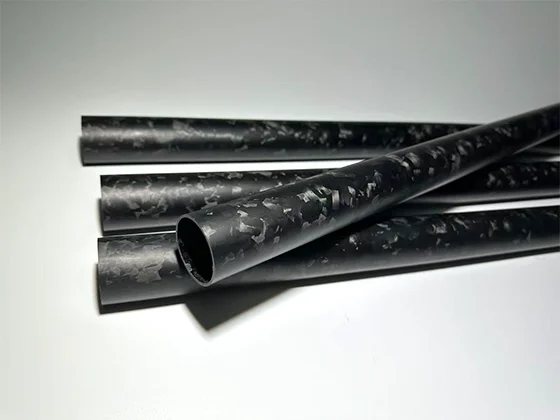
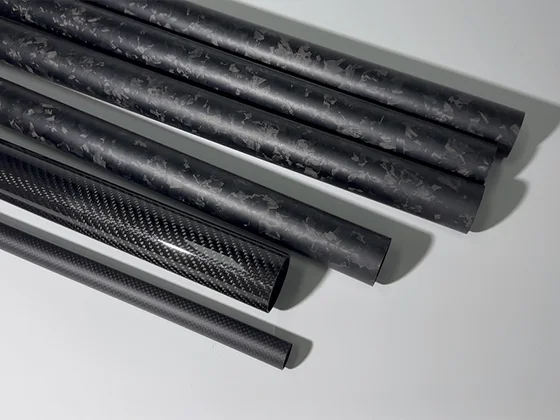
As a result, this produces a composite with a distinctive marbled appearance that looks more like natural stone than engineered fabric. No two pieces ever look exactly the same — every forged carbon fiber tube has its own unique pattern.
Notably, Lamborghini originally pioneered the technology in collaboration with Callaway Golf, aiming to produce complex composite parts faster than traditional autoclave methods allowed. Since then, it has spread across automotive, consumer electronics, sporting goods, and industrial design.
How Forged Carbon Fiber Tubes Are Made
By contrast, manufacturers build traditional carbon fiber tubes by wrapping continuous woven fabric sheets around a mandrel. Forged carbon fiber tube manufacturing takes a different approach — a hybrid roll-wrapped construction that combines visual appeal with structural integrity.
Outer layer: Forged carbon fiber prepreg (chopped fibers in resin) forms the visible surface, giving the tube its signature marbled look.
Inner layers: Unidirectional (UD) carbon fiber prepreg provides the structural backbone. These layers orient at 0°, 90°, and ±45° depending on the performance requirements.
Compression and curing: Workers wrap the assembled tube under tension and cure it at elevated temperature. Therefore, this combination delivers both visual appeal and mechanical integrity — roughly 90–95% of the tensile strength of an equivalent woven carbon tube, while gaining improved impact resistance.
Forged Carbon vs. Traditional Woven Carbon Fiber Tubes
| Property | Traditional Woven CF Tube | Forged CF Tube |
|---|---|---|
| Fiber Structure | Continuous woven fabric (2×2 twill, plain) | Chopped fibers, random orientation |
| Strength Direction | Anisotropic — strongest along fiber axis | Isotropic — uniform in all directions |
| Tensile Strength | Higher (continuous fibers carry more load) | ~90–95% of woven equivalent |
| Impact Resistance | Good in design direction, weaker off-axis | Superior — absorbs energy in all directions |
| Torsional Behavior | Can delaminate under torsional stress | Better shear resistance, less delamination |
| Visual Appearance | Consistent, repeating weave pattern | Unique marbled pattern, no two identical |
| Production Speed | Slower (hand lay-up, autoclave cure) | Faster (compression molding, minutes per cycle) |
Key Performance Advantages
Isotropic strength distribution. Because the chopped fibers point in random directions, forged carbon distributes stress evenly across the entire surface. There’s no “weak axis” like there is with woven fabrics, where off-axis loads can cause delamination.
Superior impact resistance. Furthermore, industry testing shows forged carbon can absorb up to 25–40% more impact energy than equivalent woven laminates. The random fiber interlocking prevents crack propagation, making forged carbon fiber tubes particularly suitable for applications subject to vibrations, drops, or multi-directional loads.
Lightweight. Additionally, forged tubes weigh roughly 1/5 of steel and about 60% of aluminum at equivalent dimensions. For automotive and aerospace applications, that translates directly to fuel efficiency and performance gains.
Corrosion and temperature resistance. Moreover, quality forged tubes withstand temperatures from -40°C to 120°C (with high-temp systems available up to 180°C). They resist seawater, acids, alkalis, UV exposure, and salt spray completely — no rust, no degradation.
Where Forged Carbon Fiber Tubes Excel
Automotive and motorcycle. Exhaust shroud covers, spoiler struts, interior trim accents, and decorative body components. The marbled finish pairs well with high-end vehicle interiors, and the impact resistance handles road vibration better than rigid woven alternatives.
Drones and UAVs. Drone frames and arm components benefit from forged carbon’s multi-directional strength. Landing impacts, motor vibrations, and in-flight torsion all stress the frame from varying angles — exactly the scenario where isotropic properties shine.
Photography and film equipment. Camera jibs, sliders, and tripod legs use carbon tubes for their stiffness-to-weight ratio. Forged versions add a premium visual element while maintaining the rigidity professionals demand.
Luxury goods and design. For example, walking sticks, display stands, lighting fixtures, and limited-edition products leverage forged carbon’s unique appearance. Each piece becomes visually exclusive — a characteristic that commands premium pricing.
Sporting goods. Similarly, high-end bicycle frames, fishing rods, and premium sports equipment increasingly incorporate forged carbon for its combination of impact toughness and distinctive look.
See Forged Carbon Fiber Tubes in Action
Watch the manufacturing process and see the unique marbled pattern up close.
Customization Options
Diameter Range
6mm – 1000mm+ inner diameter
Wall Thickness
0.5mm – 8mm
Maximum Length
Up to 4000mm (custom cutting available)
Fiber Grade
T300 / T700 / T800 Toray carbon fiber
Surface Finish
Glossy / Semi-matte / Matte
Internal Layup
0°/90° or 0°/±45°/90° (load-specific)
Color Options
Carbon black, or metallic flake (gold, silver, red, blue, green)
Custom Shapes
Round, square, polygon, bent tubes, custom profiles
Frequently Asked Questions
Need Forged Carbon Fiber Tubes?
Custom dimensions, surface finishes, and layup configurations available. Get a tailored quote today.