Round vs Square Kohlefaserrohre: How to Choose
Carbon fiber tubes come in round, square, and rectangular shapes — each with distinct mechanical properties and ideal applications. Choosing the wrong shape means wasted budget and suboptimal performance. Here is how to get it right.
Why Tube Shape Matters More Than You Think
Most buyers focus on carbon fiber grade (T700 vs T800), wall thickness, and surface finish — and overlook cross-sectional shape entirely. But when comparing round vs square carbon fiber tubes, shape determines how a tube handles loads, and getting it wrong can be costly.
A round carbon fiber tube under compression distributes stress evenly around its circumference. A square carbon fiber tube under the same load concentrates stress at the corners, which can initiate cracking under repeated cyclic loading. On the other hand, a square tube resists bending far better when loaded against its flat face.
💡 Key Insight
Round carbon fiber tubes are better for rotating shafts, booms, and columns — while square or rectangular carbon fiber tubes excel as structural rails, beams, or frame members where directional stiffness matters.
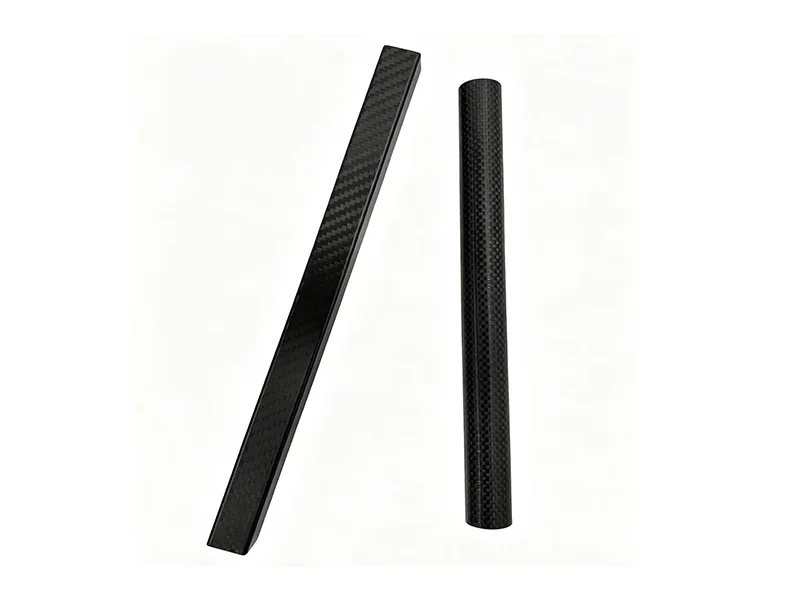
Three Shapes, Three Strengths
The All-Rounder
Round tubes are the most common carbon fiber tube shape. Their uniform cross-section provides equal strength in every direction, making them inherently resistant to buckling under axial compression.
- Uniform torsional strength — ideal for rotating applications
- Better buckling resistance per unit weight than any other shape
- Lower material cost — roll-wrapping round mandrels is faster
- Wider size availability — OD from 3mm to 200mm+
- Easier to seal, join, and integrate with standard fittings
At YTCarbon, round carbon fiber tubes account for roughly 80% of our tube orders. Available in roll-wrapped and pultruded constructions, with standard lengths up to 4 meters.
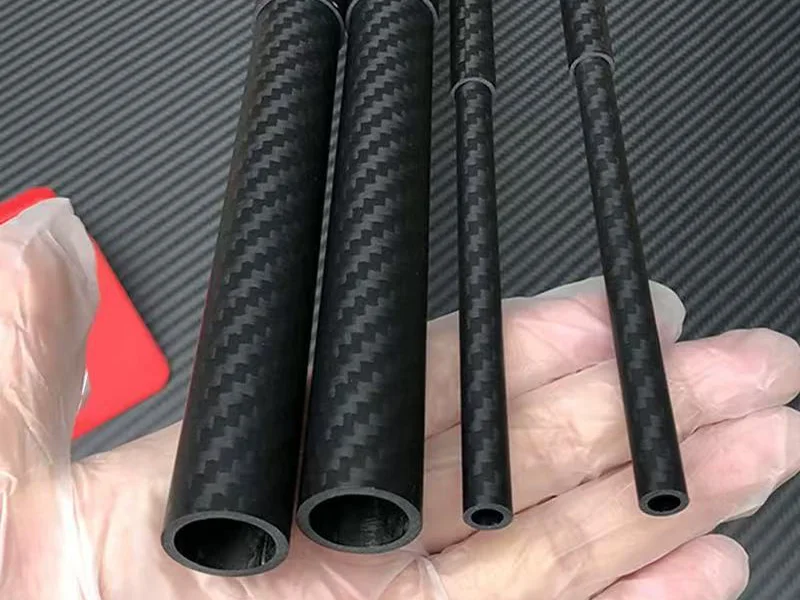
Directional Stiffness
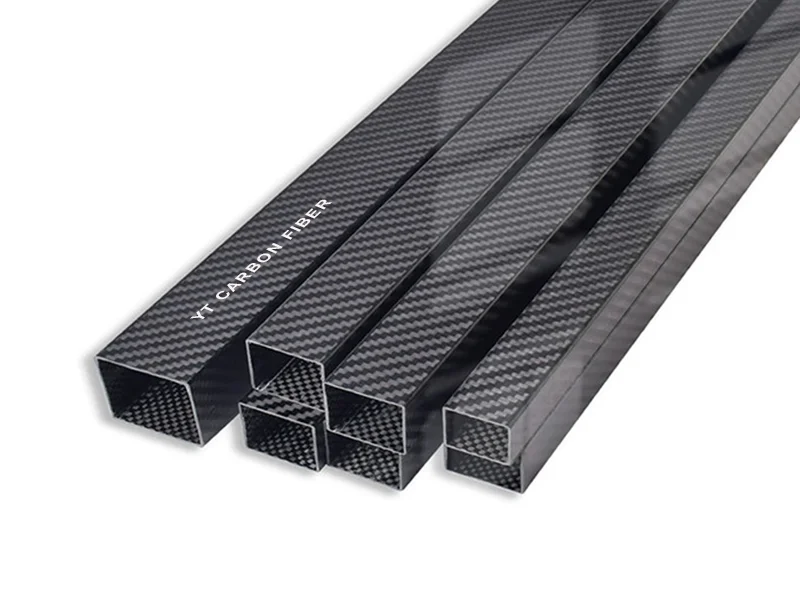
Square carbon fiber tubes shine when you need high bending stiffness in a specific direction. Their flat faces provide natural mounting surfaces — no additional brackets or fixtures needed. This makes them the default choice for linear guide rails, robotic arms, and structural frames.
- Higher moment of inertia along the flat-face axis
- Flat surfaces simplify mounting — bolts, clamps, adhesives all work directly
- Natural alignment — square profiles resist twisting during assembly
- Clean corner joints — square tubes fit together neatly in frames
However, the corners are stress concentrators under multi-directional loading, and square carbon fiber tubes cost slightly more due to more complex mandrel tooling.
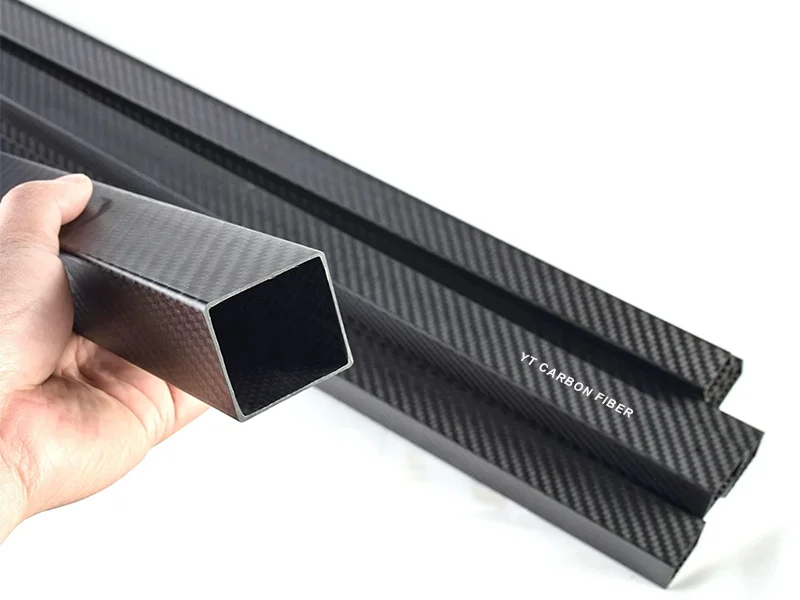
When One Axis Matters More
Rectangular carbon fiber tubes offer a middle ground in the round vs square carbon fiber tube decision. They provide high stiffness in one axis and compact dimensions in the other, invaluable when space is limited but you still need structural rigidity.
Common examples include drone arm tubes where vertical bending stiffness is critical but the horizontal profile must stay slim for aerodynamics, and industrial conveyor rails where the tube must fit within a narrow channel while supporting vertical loads.
When specifying rectangular carbon fiber tubes, always clarify which dimension is the load-bearing axis so the fiber orientation can be optimized accordingly.
Round vs Square Carbon Fiber Tube: Side-by-Side Comparison
Which Carbon Fiber Tube Shape for Your Application?
Still unsure whether to choose a round vs square carbon fiber tube? Use this quick decision guide.
Choose Round If
- Your tube rotates or experiences torsional loads
- Must resist buckling under axial compression
- Needs to be lightweight and cost-efficient above all
Drive shafts, printer rollers, telescope booms, tripod legs, support columns
Choose Square If
- Acts as a structural beam or frame member
- Needs flat surfaces for direct bolt-on mounting
- Must resist bending in a specific direction
Machine frames, robotics, camera sliders, linear guide rails
Choose Rectangular If
- Space is limited in one axis but needs stiffness in the other
- Serves as a drone arm or conveyor rail
- Replaces an aluminum extrusion in a retrofit
Drone arms, conveyor rails, narrow-channel structural beams
Manufacturing and Customization
Round carbon fiber tubes are typically produced by roll-wrapping or pultrusion. Roll-wrapping allows multi-directional fiber layup for balanced strength. Pultrusion is faster and cheaper but only aligns fibers along the tube length.
Square and rectangular carbon fiber tubes are almost exclusively roll-wrapped, since pultrusion dies for non-round profiles are expensive and inflexible. This means square and rectangular tubes generally have superior multi-directional strength compared to pultruded round tubes — but roll-wrapped round tubes remain the strongest overall.
All three carbon fiber tube shapes can be customized:
Frequently Asked Questions
Are round carbon fiber tubes stronger than square tubes?+
It depends on the load type. Round carbon fiber tubes are stronger under torsion, compression, and omnidirectional bending. Square carbon fiber tubes are stronger against bending when loaded perpendicular to their flat face. For most general-purpose applications, round tubes deliver better strength-to-weight performance.
Can I use a square carbon fiber tube instead of an aluminum extrusion?+
Yes. Many customers replace aluminum extrusion profiles with carbon fiber square tubes to reduce weight by 50–70% while maintaining comparable stiffness. The flat faces allow direct bolt-on mounting, just like aluminum profiles. Send us your aluminum profile dimensions and we will recommend an equivalent carbon fiber tube specification.
What is the minimum order quantity for custom-shaped carbon fiber tubes?+
There is no MOQ. You can order one prototype piece for testing before committing to volume production. Custom dimensions, fiber types, and surface finishes are all available on single-piece orders.
Do you offer rectangular carbon fiber tubes?+
Yes. We manufacture rectangular carbon fiber tubes with custom cross-section dimensions. Common ratios include 2:1 and 3:2 (width to height), but we can produce any ratio within our tooling capabilities. Contact our engineering team with your specific requirements.
How do I join carbon fiber tubes of different shapes?+
We offer custom CNC-machined connectors and joining inserts for round-to-round, square-to-square, and mixed-shape connections. Bonding with high-strength epoxy is also common. For structural applications, we recommend bonded inserts rather than relying on adhesive alone.
📐 Free design review
⚡ 24h engineering response
Need Help Choosing the Right Tube Shape?
Tell us your application and load requirements — our engineers will recommend the optimal cross-section, fiber grade, and wall thickness for your carbon fiber tube project.