
Micro Carbon Fiber Tubes: Specs & Sizing
Not all carbon fiber tubes are created equal. When your application calls for diameters under 10mm, you enter a different manufacturing world — tighter tolerances, specialized tooling, and a much smaller pool of capable suppliers. Here is what you need to know before specifying micro carbon fiber tubes for your next project.
What Are Micro Carbon Fiber Tubes?
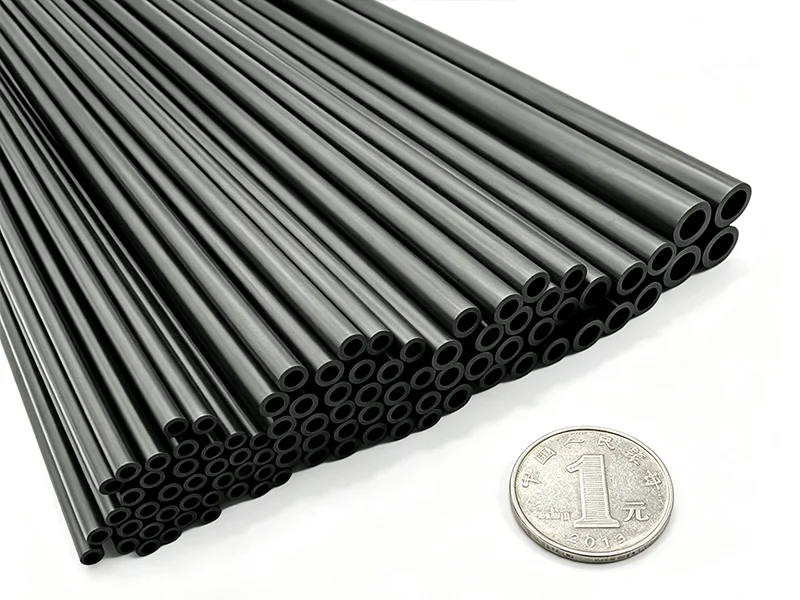
Micro carbon fiber tubes are simply carbon fiber tubes with small diameters — typically defined as inner diameters below 10mm. However, “small” does not mean “simple.” Manufacturing at this scale introduces challenges that do not exist in standard tube production.
The mandrels used to form micro tubes can be as thin as 2.5mm in diameter — about the width of a matchstick. Maintaining uniform resin distribution, consistent wall thickness, and acceptable concentricity around a mandrel this thin requires specialized equipment and experienced process control. That is why few manufacturers offer micro tubes with inner diameters below 3mm.
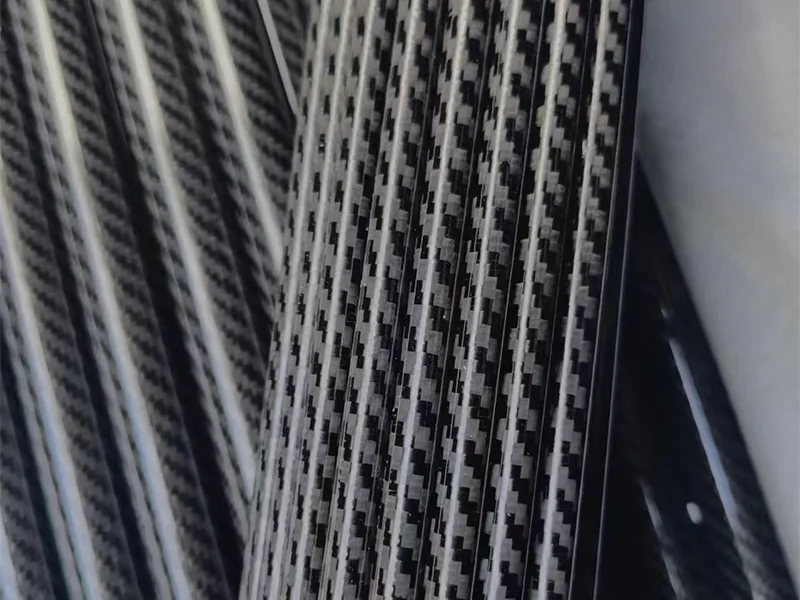
Micro tubes are available in two construction types: roll-wrapped (better concentricity, customizable layup) and pultruded (lower cost, maximum axial strength). The right choice depends entirely on your application’s load requirements and budget.
Size Range and Key Specifications
Micro carbon fiber tubes typically span the following dimensional range:
- Inner diameter: 2.5mm – 10mm
- Outer diameter: 3mm – 12mm
- Wall thickness: 0.25mm – 1mm
- Maximum length: Up to 4000mm (pultruded) or 3000mm (roll-wrapped)
Wall thickness is the critical parameter. At diameters this small, even a 0.1mm variation in wall thickness can significantly affect crush resistance and concentricity. For structural applications, we generally recommend a minimum wall thickness of 0.5mm. Thinner walls (0.25–0.4mm) are possible but should only be used for lightweight, low-load applications such as cable routing or cosmetic sleeves.
Roll-Wrapped vs. Pultruded Micro Tubes
Where Micro Carbon Fiber Tubes Shine
FPV micro drones. Whoop-class drones (65mm–85mm) use micro tubes for frame arms and structural bracing. A 3mm OD tube with 0.5mm wall weighs roughly 60% less than an equivalent aluminum tube, and that weight saving directly translates to longer flight times and faster motor response. For drone builders chasing sub-gram weight reductions, micro carbon fiber tubes are not optional — they are essential.
Medical and diagnostic equipment. Endoscope insertion tubes, surgical instrument shafts, and MRI-compatible guide tubes all benefit from carbon fiber’s unique properties: X-ray transparency, non-magnetic behavior, and dimensional stability across temperature ranges. The 2.5mm ID minimum allows integration with standard medical-grade connectors and fiber optic bundles.
RC model precision linkages. Pushrods, torque tubes, and servo linkages in RC aircraft and helicopters demand rigidity without weight. Micro carbon fiber tubes replace steel pushrods at one-fifth the weight while maintaining equal or better stiffness. The 2.5mm ID fits M2.5 hardware commonly used in precision linkages.
Precision instruments. Calibration pins, alignment shafts, and gauge tubes in measurement equipment require near-zero thermal expansion. Carbon fiber’s coefficient of thermal expansion (near 0 along the fiber axis) outperforms both steel and aluminum, ensuring dimensional stability in environments where temperature fluctuates.
Fiber optic and cable protection. Micro tubes serve as ruggedized sleeves for delicate fiber optic cables in industrial and outdoor deployments. The thin wall maximizes internal clearance while providing crush resistance, EMI shielding, and environmental protection that bare cables cannot offer.
How to Choose the Right Size
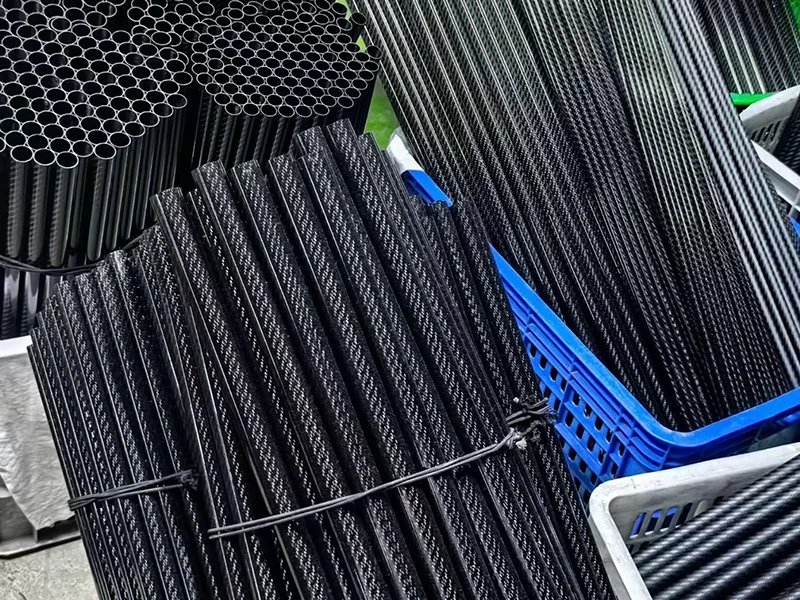
Selecting the right micro tube size comes down to three factors: internal clearance, load requirements, and mounting constraints.
Internal clearance: Your inner diameter must accommodate whatever passes through the tube — whether that is a cable bundle, a fiber optic strand, or a fastener. Always specify ID based on the actual item diameter plus a small clearance margin (0.1–0.2mm for precision fits, 0.3–0.5mm for cable routing).
Load requirements: For structural applications (drone arms, pushrods, shafts), wall thickness determines crush and bending resistance. As a rule of thumb: 0.5mm wall for light structural loads, 0.75–1mm for moderate loads. Below 0.5mm, tubes are best suited for non-structural uses like cable sleeves or decorative applications.
Mounting constraints: Outer diameter must fit within your assembly. If you are bonding the tube into a housing or bracket, the OD tolerance matters as much as the ID. Our concentricity tolerance of ≤0.1mm ensures that OD and ID stay centered — critical for press-fit and adhesive-bonded joints.
Customization Options
Frequently Asked Questions
What is the minimum inner diameter available for micro carbon fiber tubes?
The minimum inner diameter we produce is 2.5mm. This requires specialized mandrels and tight process control. Few manufacturers can reliably produce carbon fiber tubes below 3mm ID, making 2.5mm a genuine differentiator for precision applications.
Are micro carbon fiber tubes as strong as standard tubes?
Yes, the carbon fiber material properties are identical. However, due to the smaller cross-section, absolute load capacity is lower. What matters is the strength-to-weight ratio — which remains exceptional. A 3mm OD micro tube with 0.5mm wall can handle surprising loads for its size, especially in axial compression and bending.
Can micro carbon fiber tubes be used in medical devices?
Carbon fiber is X-ray translucent, non-magnetic, and offers excellent dimensional stability — making it suitable for many medical applications including endoscope shafts and MRI-compatible instruments. However, final device certification depends on your specific regulatory requirements. Contact us to discuss material documentation and compliance support.
What wall thickness should I choose for my application?
For structural applications (drone arms, pushrods, shafts), 0.5mm minimum is recommended. For moderate loads, 0.75–1mm provides a comfortable safety margin. Below 0.5mm, tubes are best for non-structural uses like cable routing or decorative sleeves. Our team can advise on the optimal thickness based on your specific load and environment conditions.
How do micro tubes compare to thin-wall carbon fiber tubes?
Thin-wall tubes (0.3–1mm wall) refer to the wall thickness regardless of diameter — they can be large or small. Micro tubes specifically target small diameters (ID under 10mm). Many micro tubes are also thin-wall, but the key difference is the diameter range. See our thin-wall tube page for larger diameter options.
Need Micro Carbon Fiber Tubes?
Custom dimensions from 2.5mm ID. Roll-wrapped or pultruded. Get a tailored quote today.