Carbon Fiber Sheet Finish Guide: Matte vs Glossy vs Forged
The surface finish of a carbon fiber sheet is not just about looks — it affects UV resistance, glare behavior, surface durability, and even how the part performs in its final application. If you are choosing between matte, glossy, and forged finishes, here is what you need to know to make the right call.
Why Your Finish Choice Matters
First of all, the finish on a carbon fiber sheet is not a coating you add after the fact — it is the result of the final surface treatment during manufacturing. Specifically, it determines how the resin-rich surface layer is processed: polished to a mirror shine, sanded to a flat texture, or left with the random marble of forged fiber.
Furthermore, each finish behaves differently in real-world conditions. Glossy surfaces reflect light and showcase the weave pattern — but they also show scratches more easily. Matte surfaces eliminate glare and hide minor surface imperfections, making them ideal for functional parts. Forged carbon offers a completely different aesthetic with its random marbled pattern, standing out from the conventional woven look.
Therefore, choosing the right finish is not purely a style decision. In addition, factors like UV exposure, mounting angle, handling frequency, and regulatory requirements all play a role. Below, we break down each option so you can choose with confidence.
Glossy Finish: Mirror-Like Clarity
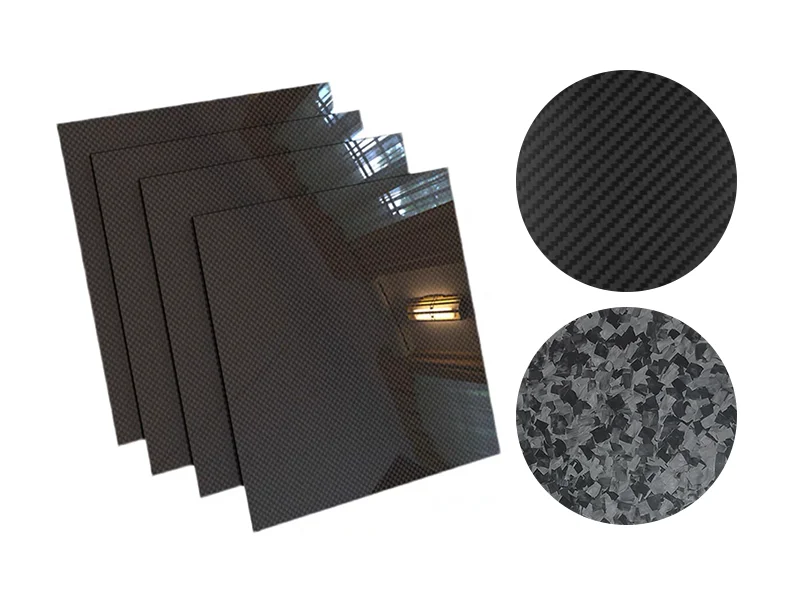
To start, a glossy finish is achieved by polishing the resin-rich surface layer until it reaches a deep, mirror-like clarity. The carbon fiber weave pattern becomes highly visible beneath the clear resin — this is the look most people associate with premium carbon fiber parts.
Key characteristics: High light reflection, vivid weave visibility, smooth tactile surface. Glossy sheets demand zero fiber print-through and zero trapped air bubbles — any surface defect becomes immediately obvious under showroom lighting.
Best applications: Exterior body panels, show car builds, visible aero components, and any part where visual impact matters. For automotive buyers, glossy is the default expectation for exterior carbon fiber.
Considerations: However, glossy surfaces show fingerprints, fine scratches, and swirl marks more readily than matte. They also create glare under direct light — something to consider for interior-facing panels in cockpits or driver-facing trim. All our glossy sheets include UV-stable clear coat as standard. See our glossy carbon fiber sheet range →
Matte Finish: Subtle and Functional
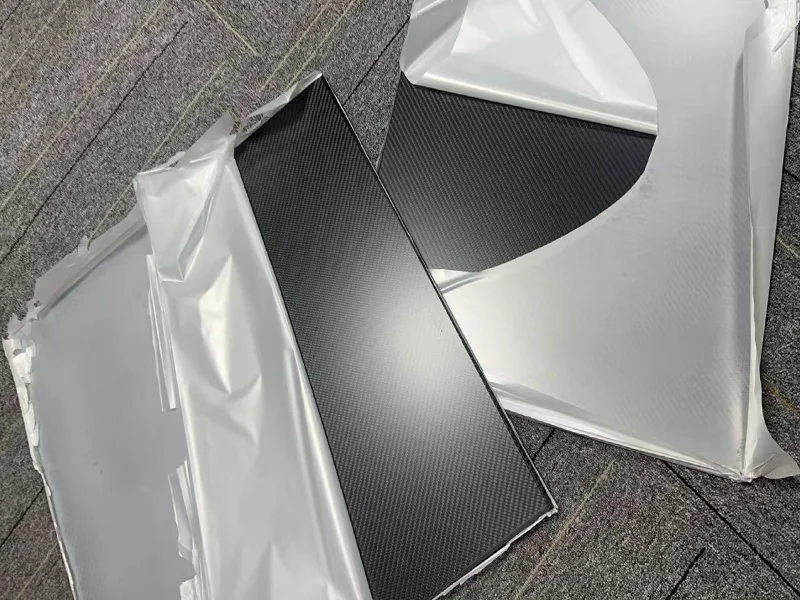
In contrast, a matte finish is created by sanding the surface with fine abrasives to remove the glossy resin layer, leaving a uniform, low-reflectivity texture. The weave pattern is still visible but appears softer and more understated.
Key characteristics: Anti-glare surface, even light diffusion, consistent texture across the entire sheet. Matte finishes hide minor handling marks and surface imperfections far better than glossy — a practical advantage for parts that get touched, mounted, or exposed to workshop conditions.
Best applications: Interior trim panels, dashboard overlays, racing cockpit components, and functional structural parts where glare would be a problem. Moreover, matte is the preferred choice in motorsport — where drivers need zero reflection from interior surfaces during high-speed driving.
Considerations: Meanwhile, matte surfaces are slightly more prone to staining from oils and grease compared to glossy. They also do not showcase the weave pattern as dramatically. However, many buyers prefer the understated look for industrial and functional applications. UV-stable clear coat is available for exterior use. See our matte carbon fiber sheet range →
Forged Finish: Unique Marbled Aesthetic
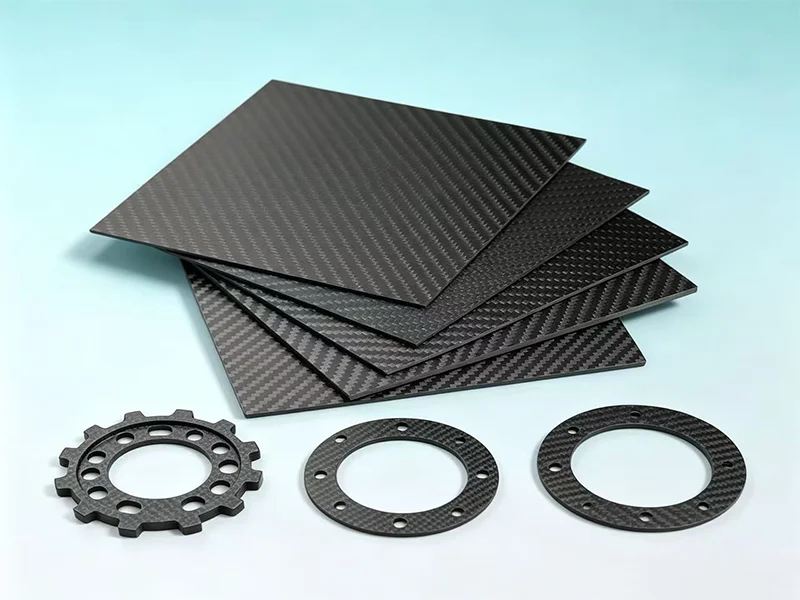
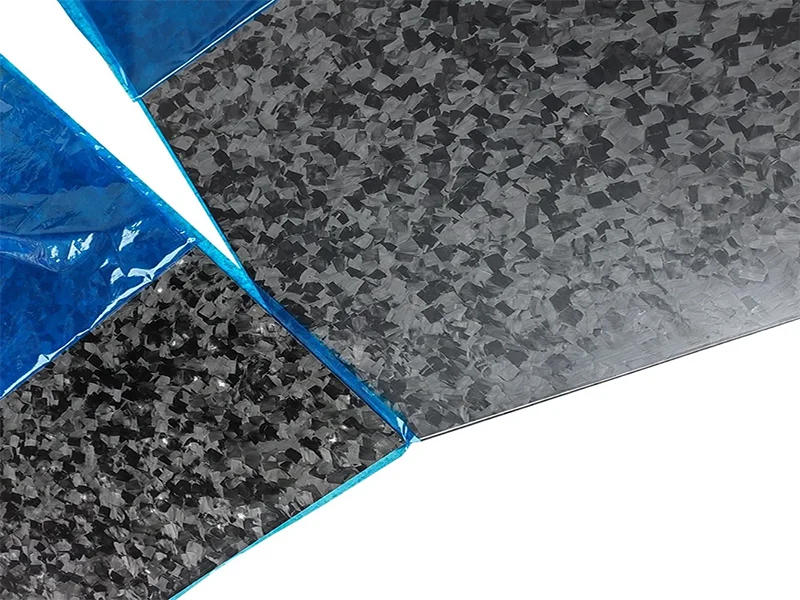
Additionally, forged carbon fiber takes a fundamentally different approach. Instead of woven fabric layers, short carbon fiber chips are compressed with resin under high pressure, creating a random, marbled pattern with no repeating weave. The result looks distinctly different from traditional carbon fiber — and that is exactly the point.
Key characteristics: Random marbled pattern, no two sheets identical, available in glossy or matte surface treatment. Forged sheets offer comparable mechanical properties to woven sheets in most applications, though multi-directional strength distribution differs due to the random fiber orientation.
Best applications: High-end automotive interiors, supercar trim panels, custom builds where visual distinction matters, and branding-oriented products. Forged carbon has become a signature material in luxury and premium segments.
Considerations: Notably, forged carbon fiber sheets typically cost more than woven equivalents due to the specialized manufacturing process. Furthermore, the random pattern means you cannot match seams between adjacent panels as you can with a consistent weave — a consideration for large multi-panel installations. See our forged carbon fiber sheet range →
Finish Comparison at a Glance
How to Choose the Right Finish
Ultimately, the right finish depends on three factors: visibility, environment, and budget.
Visibility: First, if the part is a visible showpiece — exterior panel, display component, or branding surface — glossy delivers the most dramatic visual impact. If the part needs to look premium without drawing attention, matte is the better choice. For something entirely different, forged makes a bold statement.
Environment: Second, consider where the part lives. Exterior applications need UV-stable clear coat regardless of finish. Interior parts facing the driver should avoid glossy surfaces that create glare. Parts handled frequently benefit from matte or forged finishes that conceal fingerprints and minor marks.
Budget: Finally, glossy and matte finishes are comparably priced. Forged carbon fiber carries a premium due to its specialized manufacturing process. If budget is tight and you need a standard woven look, glossy or matte delivers equal performance at lower cost.
Frequently Asked Questions
Finish Selection
Can I change the finish of a carbon fiber sheet after purchase?
Technically, yes. You can sand a glossy sheet to matte, or polish a matte sheet back to glossy. However, this requires skill and the right abrasives. Furthermore, DIY refinishing risks uneven surface texture, fiber exposure, and loss of the UV-protective clear coat. Therefore, we recommend ordering the correct finish from the start.
Which finish is best for outdoor automotive use?
For exterior panels, glossy with UV-stable clear coat is the most popular choice. The clear coat prevents yellowing and surface degradation from UV exposure. Meanwhile, matte is also suitable for exterior use with the same UV clear coat. In either case, proper care and occasional waxing will extend the surface life significantly.
Does the finish affect the mechanical strength of the sheet?
No, not significantly. The finish only affects the surface resin layer — typically 0.02–0.05mm deep. Consequently, the underlying laminate structure, fiber orientation, and resin system determine mechanical properties. A glossy sheet and a matte sheet of the same specification have virtually identical strength and stiffness.
Ordering & Customization
Can I order one side glossy and the other side matte?
Yes, we offer dual-finish sheets. Specifically, one side is polished to glossy and the other is sanded to matte. This is common for interior panels where the visible face needs a premium glossy look, while the back faces a mounting surface where glare and marking are irrelevant.
Is forged carbon fiber weaker than woven carbon fiber?
Not necessarily. Forged carbon fiber uses randomly oriented short fibers, so its strength distribution is more isotropic — meaning it performs similarly in all directions. In contrast, woven sheets are stronger along the fiber axis but weaker at 45° off-axis. Therefore, for applications with multi-directional loads, forged can actually perform equivalently or better.
Need Help Choosing the Right Finish?
Glossy, matte, or forged — tell us your application and we will recommend the best option. Quote in 24h.